
Cyber Threat Intelligence and Autonomous Cyber Intelligence
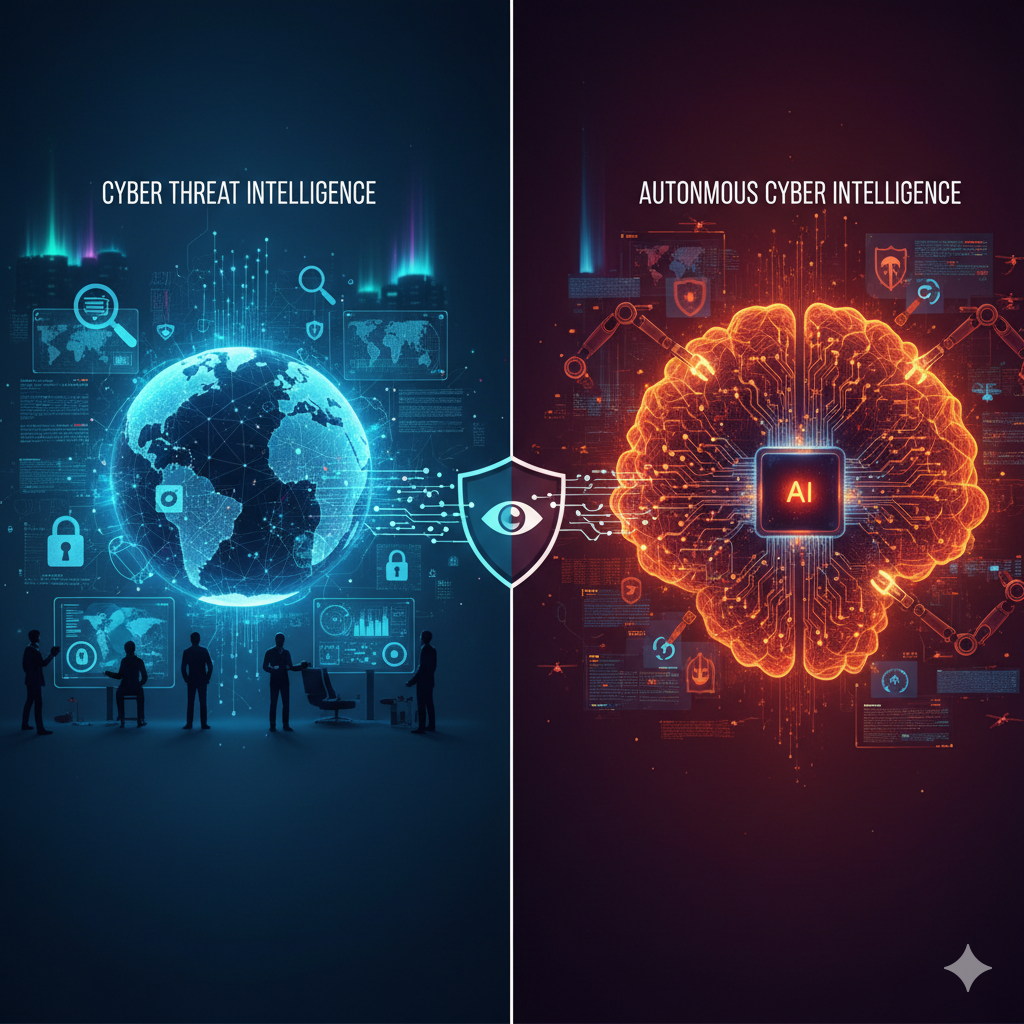
In 2026, cyber threat intelligence (CTI) converges with autonomous cyber intelligence to redefine enterprise defense, pitting AI-orchestrated attacks against self-governing, agentic security ecosystems. Traditional CTI delivering strategic insights on adversary campaigns, tactical TTPs via MITRE ATT&CK, and technical IOCs evolves into autonomous systems that independently collect, analyze, predict, and respond at machine speeds unattainable by humans. As attackers deploy purpose-built AI agents for reconnaissance, lateral movement, ransomware deployment, and data exfiltration without oversight, defenders counter with autonomy with control AI firewalls governing agent behaviors, predictive fusion engines, and unified SOCs automating the full intelligence lifecycle. Global cybercrime, fueled by autonomous AI scaling attacks across hybrid environments, projects losses exceeding $23 trillion by 2027, with sectors like healthcare, manufacturing, and cloud services most vulnerable. The business imperative is stark: legacy human-dependent SOCs collapse under alert volumes where AI agents outnumber humans 82:1, demanding a shift from reactive triage to proactive, self-defending networks. Autonomous cyber intelligence fuses external feeds (OSINT, dark web) with internal telemetry for real-time risk scoring, automated containment, and continuous learning, slashing MTTD/MTTR by orders of magnitude. At Informatix.Systems, we provide cutting-edge AI, Cloud, and DevOps solutions for enterprise digital transformation, enabling seamless deployment of autonomous CTI platforms that turn threats into fortified intelligence. This comprehensive guide details frameworks, implementation roadmaps, 2026 trends like AI vs. AI battles and identity as the new perimeter, and strategies for CISOs to build resilient, autonomous defenses amid agentic threats, supply chain poisons, and quantum risks.
Foundations of Cyber Threat Intelligence
Cyber threat intelligence systematically processes threat data into actionable knowledge across four levels: strategic (geopolitical trends), operational (campaign targeting), tactical (TTPs and tools), and technical (IOCs like malicious IPs or hashes). In autonomous contexts, CTI feeds AI agents for baseline establishment and anomaly detection.
Core CTI Components
- Indicators of Compromise (IOCs): Static artifacts for blocking.
- Tactics, Techniques, Procedures (TTPs): Behavioral patterns for prediction.
- Indicators of Behavior (IOBs): Dynamic for autonomous adaptation.
Autonomy amplifies CTI by enabling 24/7 operation without fatigue.
Autonomous Cyber Intelligence Defined
Autonomous cyber intelligence deploys agentic AI systems that independently execute the CTI lifecycle: planning requirements, collecting multi-source data, processing/enriching, analyzing for predictions, disseminating via SOAR, and feeding back for self-improvement. Unlike assistive AI, these agents reason, adapt goals, and respond, e.g., isolating compromised nodes pre-human alert.
Key Autonomous Capabilities
- Self-Orchestration: Multi-agent collaboration for complex hunts.
- Predictive Autonomy: Forecasting TTP evolutions.
- Zero-Touch Response: Patching, quarantining at machine speed.
This transforms SOCs into self-defending ecosystems.
Evolution to Autonomous CTI
2026 marks the inflection: from human-led CTI to agentic dominance, driven by AI maturity, closing the 4.8M skills gap. Attackers' autonomous agents (e.g., evolved FraudGPT) force parity; defenders respond with fused intelligence engines prioritizing by asset value and exposure.
Transition Milestones:
- 2025: AI-assisted analysis.
- 2026: Fully autonomous cycles with human oversight.
At Informatix.Systems, we provide cutting-edge AI, Cloud, and DevOps solutions for enterprise digital transformation.
Enhanced CTI Lifecycle for Autonomy
The iterative six-phase model gains agency: AI plans via risk models, collects via APIs/sensors, processes with NLP/ML, analyzes via graph networks, disseminates contextually, and refines autonomously.
Autonomous Phase Upgrades
Feedback loops ensure evolution.
2026 Trends in Autonomous Intelligence
Agentic AI redefines CTI: autonomous insiders as threats/targets, unified visibility across edge/OT/IoT, exposure management, and metrics-driven SOCs. Identity becomes the operational backbone amid the machine identity explosion.
Dominant Trends:
- AI Arms Race: Autonomous triage vs. attacks.
- Collective Autonomy: Shared agent intelligence.
- Quantum-Ready Agents: Post-quantum adaptation.
Building Autonomous CTI Teams
Hybrid teams: AI orchestrators, ethicists, analysts (5-20 members). Skills emphasize agent governance, not manual hunting. Leverage MSSPs for scale.
Team Structure
| Role | Responsibilities | Expertise |
|---|---|---|
| Autonomy Lead | Agent policy | AI governance |
| Fusion Engineer | Pipeline integration | ML ops |
| Validator | Human-AI loops | Red-teaming |
Simulations build proficiency.
Top Autonomous CTI Platforms
Leaders: Palo Alto (AI firewalls), Seceon Open XDR (self-learning), Cyware (agentic CTI), Anomali (fusion). Evaluate the autonomy depth, integration, and control mechanisms.
Platform Comparison
| Platform | Autonomy Level | Key Feature |
|---|---|---|
| Seceon XDR | Full lifecycle | Predictive response |
| Palo Alto | Agent governance | Insider threat control |
| Cyware | Proactive agents | TTP operationalization |
Open-source MISP for sharing.
KPIs and Metrics for Autonomous Success
Track autonomy rate (90%+ actions), prediction precision, human intervention reduction, breach prevention ROI. Monitor agent uptime and ethical compliance.
Vital Metrics:
- Response Velocity: Seconds vs. hours.
- Coverage Gaps: Autonomous blind spots.
- Adaptation Speed: Model retrain cycles.
Dashboards enable oversight.
Secure Autonomous Sharing Protocols
TAXII/STIX 2.1+ with federated learning for privacy-preserving autonomy. ISACs evolve to agent exchanges, accelerating collective defense by 60%.
Best Practices:
- Agent Verification: Blockchain ledgers.
- Granular Controls: Role-based autonomy.
- Audit Trails: Immutable logs.
Real-World Autonomous CTI Deployments
Enterprises using Seceon-like platforms neutralized AI-orchestrated ransomware autonomously, cutting costs 70%; manufacturing firms contained OT intrusions pre-disruption. Lessons: start with high-value assets.
Success Factors:
DevSecOps with Autonomous Intelligence
Embed agents in pipelines for autonomous vuln prediction, code scanning, and deployment gates. Fuses CTI with SCA for self-healing CI/CD, reducing prod escapes 75%.
Integration Roadmap:
- Agent Ingestion: Real-time feeds.
- Policy Autonomy: Auto-enforce.
- Feedback Fusion: Enrich global intel.
At Informatix.Systems, we provide cutting-edge AI, Cloud, and DevOps solutions for enterprise digital transformation.
Leadership Skills for the Autonomous Era
CISOs master agent orchestration, ethical AI, identity fabrics, and metrics storytelling. Certifications: CCSP, AI security tracks.
Skill Pillars:
Maturity Model for Autonomous CTI
NIST-aligned: Level 1 (manual), Level 3 (assisted), Level 5 (full autonomy with governance). Benchmark quarterly.
Pathway:
Countering Autonomous Adversaries
Deploy AI governance firewalls, adversarial robustness training, zero-trust agents, and provenance tracking. CTI arms these dynamically.
Defense Layers:
- Runtime Controls: Behavior bounds.
- Swarm Defense: Multi-agent counters.
- Kill Switches: Emergency halts.
Regulatory Landscape for Autonomy
2026 mandates: AI transparency reporting, autonomous response audits, EU AI Act compliance. Ethical CTI ensures accountability.
Ecosystem and Vendor Strategies
Collaborate via AI threat alliances; POC platforms rigorously. Hybrid managed services bridge gaps.
2027 Horizons: Hyper-Autonomy
Neuromorphic agents, global intel meshes, quantum autonomy. Pioneers gain insurmountable edges. Cyber threat intelligence and autonomous cyber intelligence herald 2026's defender renaissance, automating resilience against agentic onslaughts through predictive, self-orchestrating defenses. Mastering lifecycles, platforms, DevSecOps fusion, and maturity models delivers unmatched ROI and security. Secure your autonomous future with Informatix.Systems. Connect at https://informatix.systems for AI, Cloud, and DevOps solutions that embrace autonomy, dominate threats.
FAQs
What differentiates autonomous cyber intelligence from CTI?
Autonomous executes full lifecycle independently; CTI provides data foundation.
How do agentic AI threats impact enterprises?
They scale attacks sans humans, targeting AI insiders.
Top platforms for autonomous CTI?
Seceon XDR, Palo Alto agents, Cyware proactive.
Key KPIs for autonomous programs?
Autonomy rate, response speed, and prediction accuracy.
Sharing best practices in autonomous setups?
Federated STIX with agent verification.
Autonomous role in DevSecOps?
Self-healing pipelines and predictive gates.
Skills for autonomous CTI leaders?
Agent governance, ethical AI, metrics.
Implementation challenges?
No posts found
Write a review