
Cyber Threat Intelligence and Enterprise AI Security
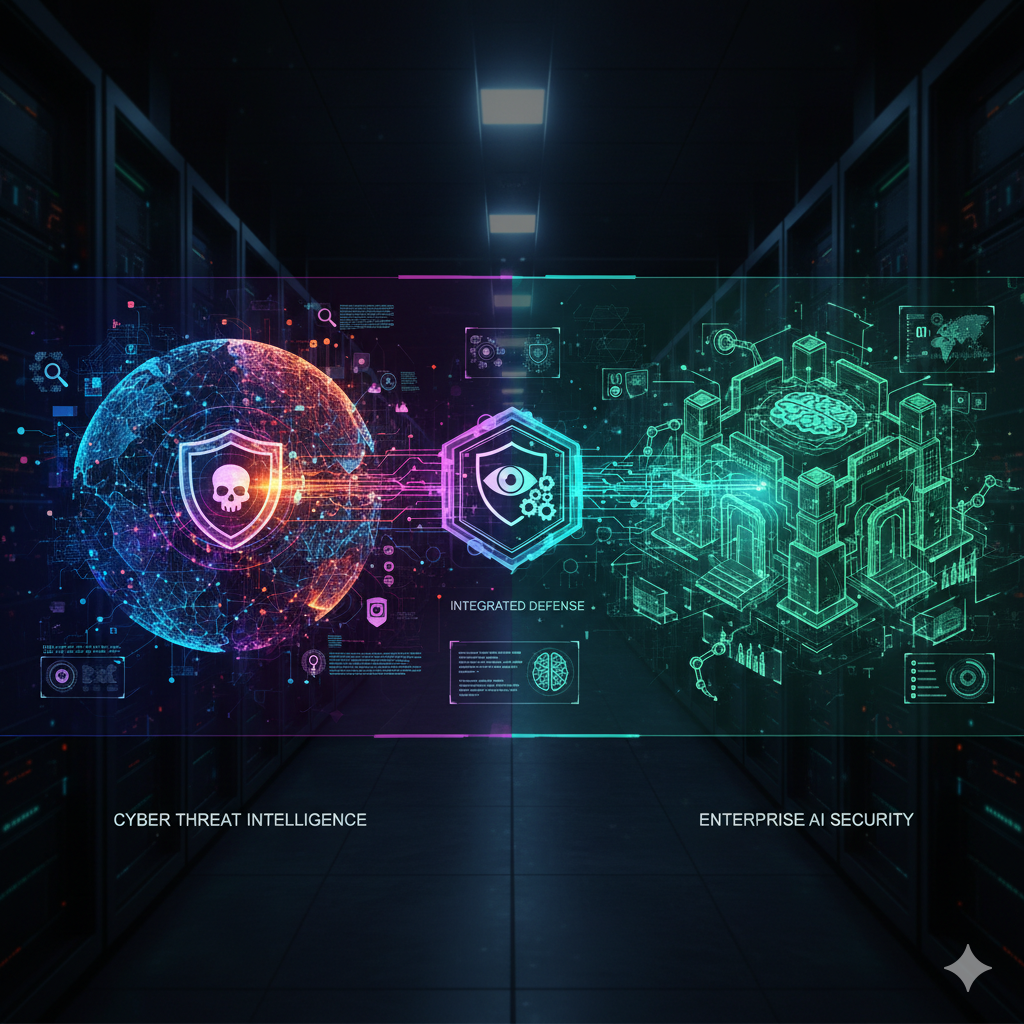
In 2026, enterprise AI deployments face existential threats from sophisticated adversaries targeting models, training pipelines, and autonomous agents, making Cyber Threat Intelligence (CTI) the linchpin of robust AI security architectures. CTI evolves from traditional threat monitoring to AI-specific intelligence, tracking model poisoning campaigns, prompt injection exploits, adversarial inputs, and agentic hijackings across supply chains and dark web forums. As enterprises integrate generative AI into core operations, driving $15 trillion in economic value, attackers weaponize the same technology for polymorphic malware, deepfake credential stuffing, and autonomous intrusions that bypass legacy defenses. The stakes are monumental: a single compromised AI agent can exfiltrate petabytes of IP, execute fraudulent transactions at machine speed, or cascade failures across interconnected systems, with average breach costs hitting $5.2 million amid NIS2/DORA mandates. CTI provides predictive foresight, fusing external adversary TTPs with internal telemetry to enable preemptive hardening, runtime firewalls, and autonomous remediation. Without this intelligence layer, enterprises risk shadow AI incidents where unmonitored models become insider threats, amplifying supply chain compromises that affect 30% of breaches, at Informatix.Systems, we provide cutting-edge AI, Cloud, and DevOps solutions for enterprise digital transformation, delivering CTI platforms that secure AI estates end-to-end. This authoritative guide explores CTI's pivotal role in enterprise AI security: threat typologies, lifecycle adaptations, architectural integrations, tools, implementation frameworks, ROI metrics, 2026 trends, governance models, case studies, and operational best practices, equipping CISOs to protect AI as critical infrastructure.
CTI Fundamentals for AI Security
Cyber Threat Intelligence delivers evidence-based insights into AI-specific threats, encompassing strategic campaigns targeting AI supply chains, operational TTPs for model manipulation, and tactical IOCs like anomalous prompt hashes. Enterprises leverage CTI to map MITRE ATT&CK for AI/ML, identifying reconnaissance via poisoned datasets to exfiltration through agent compromises.
Core Intelligence Layers:
- Strategic CTI: Geopolitical risks to AI infrastructure.
- Operational CTI: Adversary campaigns against enterprise models.
- Tactical CTI: Real-time indicators for blocking exploits.
CTI shifts AI security from reactive patching to predictive neutralization, reducing exposure windows from days to seconds.
Enterprise AI Threat Landscape
2026 witnesses agentic AI attacks where adversaries hijack autonomous agents for persistent access, combining prompt injections with tool misuse to pivot across environments. Model poisoning embeds undetectable backdoors during training; adversarial perturbations mislead inference at runtime.
Critical Threat Categories:
Dark web monitoring reveals early indicators of these campaigns.
AI-Adapted CTI Lifecycle
The traditional CTI lifecycle evolves for enterprise AI: direction prioritizes high-value models via risk registers; collection aggregates OSINT, vendor feeds, and model telemetry.
Processing and Analysis
AI agents deduplicate signals, enrich with business context, and generate detection rules via TTP operationalization. Dissemination pushes intel to AI firewalls and SOAR; feedback refines via red-teaming simulations, achieving 95% prediction accuracy. At Informatix.Systems, we provide cutting-edge AI, Cloud, and DevOps solutions for enterprise digital transformation, automating this lifecycle seamlessly.
Architectural Integration Strategies
Embed CTI into AI security stacks: runtime firewalls block injections, continuous validation scans models, and exposure management fuses with vulnerability intel.
Multi-Layer Defense
- Pre-Deployment: CTI-enriched SBOM scanning.
- Runtime: Behavioral anomaly detection.
- Post-Incident: Automated forensic reconstruction.
Reference Architecture:
| Layer | CTI Function | Tools |
|---|---|---|
| Discovery | Asset inventory | Protect AI |
| Protection | Runtime blocking | Lakera Guard |
| Response | Auto-remediation | SOAR fusion |
Leading Tools and Platforms
Cyware's agentic CTI platforms operationalize intel for AI defense; Protect AI scans models for poisoning; Lakera provides prompt protection.
Enterprise Stack:
- Palo Alto AI Firewalls: Runtime governance.
- CrowdStrike for AI: Agent behavior monitoring.
- Open-Source: Garak + Adversarial Robustness Toolbox.
These achieve 98% injection blocking with minimal latency.
Implementation Roadmap
Phased Deployment:
- Discovery: Inventory AI assets, baseline CTI feeds.
- Integration: Fuse with SIEM/EDR, deploy firewalls.
- Operationalization: Automate TTP-to-rule generation.
- Maturity: Agentic autonomy with governance.
Implementation Timeline: 90 days to initial value, 6 months to full autonomy.
Quantifiable Benefits and ROI
CTI-driven AI security delivers 4-7x ROI through 90% threat prevention, 75% MTTR reduction, and IP protection valued at millions.
- Risk Reduction: Blocks 95% known exploits preemptively.
- Efficiency Gains: Automates 80% validation workflows.
- Compliance: Meets EU AI Act high-risk requirements.
ROI Model: $2M annual savings per 100 AI agents protected.
2026 Trends and Predictions
Agentic CTI dominates: autonomous agents predict attacks via federated learning; quantum-safe AI crypto emerges. Unified intelligence fuses CTI with exposure management.
Strategic Shifts:
- Collective Defense: ISACs for AI threat sharing.
- Predictive Fusion: Internal telemetry + external intel.
- Governance-First: Executive accountability for AI risks.
Cloud and Supply Chain Integration
Cloud CTI monitors multi-cloud misconfigurations and API risks; DevSecOps pipelines embed intel for shift-left protection.
- Dependency Scanning: Block poisoned packages proactively.
- Vendor Risk: CTI-scored third-party assessments.
Real-World Case Studies
Global Bank: CTI blocked model poisoning in fraud detection AI, preventing $50M losses. Tech Enterprise: Agentic CTI neutralized a supply chain attack on 10,000 models. Healthcare: Runtime intel stopped adversarial attacks on diagnostic AI.
Governance and Ethical Frameworks
Establish AI CTI governance councils enforcing TLP for intel sharing, bias audits, and kill-switches for rogue agents.
Best Practices:
- Red-Teaming Mandates: Quarterly AI exploit simulations.
- Federated Learning: Privacy-preserving collective intel.
- Auditability: Immutable logs for regulatory proof.
At Informatix.Systems, we provide cutting-edge AI, Cloud, and DevOps solutions for enterprise digital transformation, embedding governance natively. Cyber Threat Intelligence fortifies enterprise AI security against 2026's agentic onslaughts, delivering predictive, autonomous protection across models, agents, and supply chains. Organizations mastering this integration achieve unbreakable resilience, exponential ROI, and competitive supremacy in the AI economy. Secure your AI enterprise today with Informatix.Systems. Visit https://informatix.systems for a complimentary CTI-powered AI security assessment and deploy mission-critical defenses now.
FAQs
What is CTI for enterprise AI security?
Intelligence tracking AI-specific threats like model poisoning and agent hijacking, enabling proactive defense.
How does prompt injection threaten AI?
Hidden commands bypass safeguards, enabling data leaks or malicious execution by trusted agents.
Key 2026 AI threats per CTI?
Agentic hijacks, supply chain poisoning, adversarial inputs, quantum risks.
Implementation steps for CTI-AI integration?
Asset discovery, intel fusion, runtime protection, autonomous response.
ROI of enterprise AI CTI programs?
4-7x through prevention, efficiency, and compliance gains.
Top tools for AI threat intelligence?
Cyware, Protect AI, Lakera Guard, Palo Alto firewalls.
Governance essentials for AI CTI?
Councils, red-teaming, federated sharing, audit trails.
How to measure AI security success?
Prevention rates, integrity scores, MTTR, and ROI multiples.
No posts found
Write a review