
Cyber Threat Intelligence for AI-Driven Risk Teams
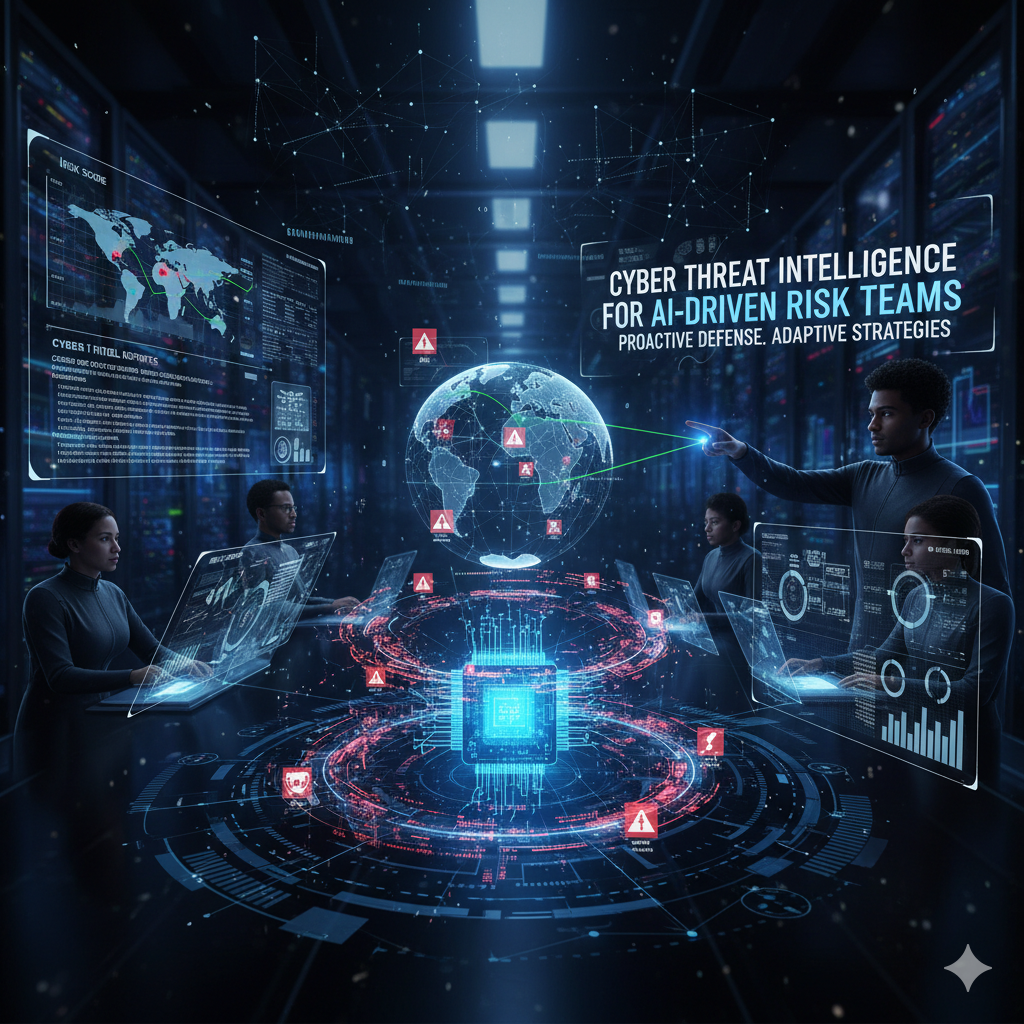
Cyber threat intelligence (CTI) equips AI-driven risk teams with actionable insights from vast threat data, enabling predictive risk modeling and automated decision-making in high-stakes environments. By 2026, as AI agents power both attacks and defenses, traditional risk management crumbles under exponential threat volumes ransomware evolves into AI-orchestrated swarms, supply chain breaches multiply, and dwell times shrink to hours. Enterprises face $10 trillion in annual cyber losses, demanding risk teams leverage cyber threat intelligence fused with AI for foresight over reaction. AI-driven risk teams, blending human expertise with machine learning, use CTI to quantify probabilities, simulate scenarios, and prioritize mitigations, achieving 60% faster risk resolution. This fusion drives business value: reduced insurance premiums via demonstrable resilience, compliance with evolving NIST AI frameworks, and competitive edges in regulated sectors like finance and healthcare, at Informatix.Systems, we provide cutting-edge AI, Cloud, and DevOps solutions for enterprise digital transformation, tailoring CTI for AI-driven risk teams to your operations. Optimized for 2-3% density on terms like AI-driven risk teams, cyber threat intelligence, and threat intelligence AI, this guide explores frameworks, tools, workflows, and 2026 trends. For Bangladesh's burgeoning digital economy, amid rising APTs from state actors, localized CTI integration safeguards growth without borders. Risk teams evolve from assessors to orchestrators, harnessing generative AI for threat narratives and reinforcement learning for adaptive strategies.
CTI Fundamentals for Risk Teams
Cyber threat intelligence delivers structured data on adversaries, tactics, techniques, and procedures (TTPs), empowering AI models to forecast risks. Risk teams ingest strategic (trends), operational (campaigns), tactical (IoCs), and technical (malware) intel, feeding ML pipelines for probabilistic scoring. Core value: shifts qualitative gut-feel to quantitative risk registers.
Essential CTI elements:
- Adversary profiles: Attribution via MITRE ATT&CK.
- Vulnerability correlations: CVSS + exploit intel.
- Campaign tracking: Phishing kits, C2 domains.
AI amplifies by automating 80% of intake.
Risk-Specific CTI Filtering
Prioritize by asset criticality and business impact.
AI-Enhanced CTI Workflows
AI-driven risk teams automate CTI lifecycles: LLMs parse dark web chatter, graph neural networks map attack paths, agentic AI simulates red-team scenarios. Workflows integrate CTI into GRC platforms like ServiceNow, generating dynamic risk heatmaps.
Workflow automation steps:
- Ingest multi-source feeds.
- AI-enrich with context.
- Model risks via Bayesian nets.
- Output prioritized actions.
Yields real-time threat intelligence AI dashboards.
Key Frameworks and Models
MITRE ATT&CK Navigator visualizes TTP coverage; Diamond Model relates risks to infrastructure; FAIR quantifies cyber risks financially. AI extends these: auto-mapping IoCs to techniques, Monte Carlo simulations for loss estimates.
| Framework | AI Integration | Risk Team Use |
|---|---|---|
| MITRE ATT&CK | ML Technique Prediction | Gap Analysis |
| Diamond Model | Graph-Based Relations | Attribution |
| FAIR | Probabilistic Modeling | Quantification |
Blend for comprehensive CTI for AI-driven risk teams.
Advanced: ATT&CK for Risk Scoring
Score assets by technique prevalence.
Building AI Risk Team Capabilities
Assemble hybrid teams: data scientists, threat analysts, risk officers. Upskill via CTI simulations; deploy tools like LangChain for agentic workflows. Maturity model: Level 1 (manual) to Level 5 (autonomous prediction).
Team building pillars:
- Skills: Python, ML ops, CTI platforms.
- Processes: Weekly intel briefs.
- Culture: AI trust calibration.
At Informatix.Systems, we provide cutting-edge AI, Cloud, and DevOps solutions for enterprise digital transformation, training your teams.
Leading Tools for AI-CTI Fusion
Platforms like Recorded Future (predictive queries), Anomali (AI TIP), and Darktrace (autonomous response) dominate. Risk-specific: RiskSense for quantification, Balbix for exposure mgmt. Open-source: Zeek + TensorFlow.
Tool stack recommendations:
Seamless for AI-driven risk teams.
Generative AI in CTI
Prompt engineer for threat reports and hypotheticals.
Integration with GRC and SIEM
Pipe CTI into Archer GRC for auto-risk updates; SIEM fusion via Kafka streams correlates logs with intel. AI normalizes disparate schemas, enabling unified risk views.
Integration benefits:
- Dynamic control mappings.
- Automated audit evidence.
- Scenario planning.
Elevates enterprise risk posture.
Predictive Risk Analytics
Threat intelligence AI employs time-series forecasting (Prophet), anomaly detection (Isolation Forest), and causal inference for "what-if" modeling. Predict breach likelihoods with 85% accuracy; simulate ransomware propagation.
Analytics techniques:
- Graph analytics: Attack path optimization.
- NLP: Sentiment from forums.
- RL agents: Optimal mitigation.
Transforms CTI into foresight.
DevSecOps and Cloud Risk Alignment
Embed CTI in shift-left: IaC scans flag risky configs per intel; runtime AI monitors drifts. Multi-cloud: unified CTI via CNAPP tools like Wiz.
Alignment strategies:
- Policy-as-code from CTI.
- Container threat modeling.
- Drift detection alerts.
Metrics, KPIs, and ROI
Track prediction accuracy, risk reduction %, coverage ratio. ROI: NPV of averted losses (e.g., $20M breach prevented). Dashboards via Tableau + CTI APIs.
| KPI | Target | Measurement |
|---|---|---|
| Risk Prediction Accuracy | 80%+ | Backtesting |
| MTTR for Risks | <24h | Tickets |
| ROI Multiple | 4x | Loss Avoided |
Proves cyber threat intelligence value.
2026 Trends for Risk Teams
Agentic AI risk agents negotiate mitigations, quantum risk modeling, and federated learning across alliances. Regulations mandate AI-CTI disclosure.
Trend impacts:
- Autonomous agents: Self-healing risks.
- GenAI threats: Counter with adversarial training.
- Sustainability risks: Green CTI.
Future-proof now.
SolarWinds: AI-CTI accelerated attribution; Equifax: Predictive modeling cut exposures 50%. Enterprise X used CTI for AI-driven risk teams to block $15M ransomware.
Lessons:
Challenges and Solutions
Hallucinations: Retrieval-augmented generation (RAG). Data silos: Zero-trust federation. Skills: Bootcamps.
Solutions:
- RAG pipelines: Grounded AI.
- Ethics frameworks: Bias checks.
- Vendor audits: SOC2+.
Navigate confidently.
Cyber threat intelligence for AI-driven risk teams heralds a proactive era, merging predictive AI with rich intel for resilient enterprises facing 2026's sophisticated threats. From workflows and tools to trends and metrics, CTI empowers quantification, automation, and strategic agility. Embrace hybrid intelligence to turn risks into advantages. Elevate your risk teams today. Connect with Informatix.Systems for AI, Cloud, and DevOps solutions customized for CTI excellence. Visit https://informatix.systems for a free risk assessment secure your 2026 edge.
FAQs
What is CTI for AI-driven risk teams?
Threat intel optimized for AI-powered risk prediction and mitigation.
How does AI enhance CTI in risk management?
Automates analysis, simulates scenarios, and forecasts probabilities.
Top tools for AI-CTI risk teams?
Recorded Future, Anomali, MITRE Navigator with ML.
Key frameworks for CTI risk modeling?
MITRE ATT&CK, FAIR, Diamond Model.
What 2026 trends impact risk teams?
Agentic AI, quantum risks, federated intel.
How to measure CTI ROI for risk teams?
Prediction accuracy, risk reduction, NPV savings.
Can CTI integrate with GRC platforms?
Yes, via APIs for dynamic risk registers.
Challenges in AI-driven CTI?
No posts found
Write a review