
Cyber Threat Intelligence for AI-Native Security
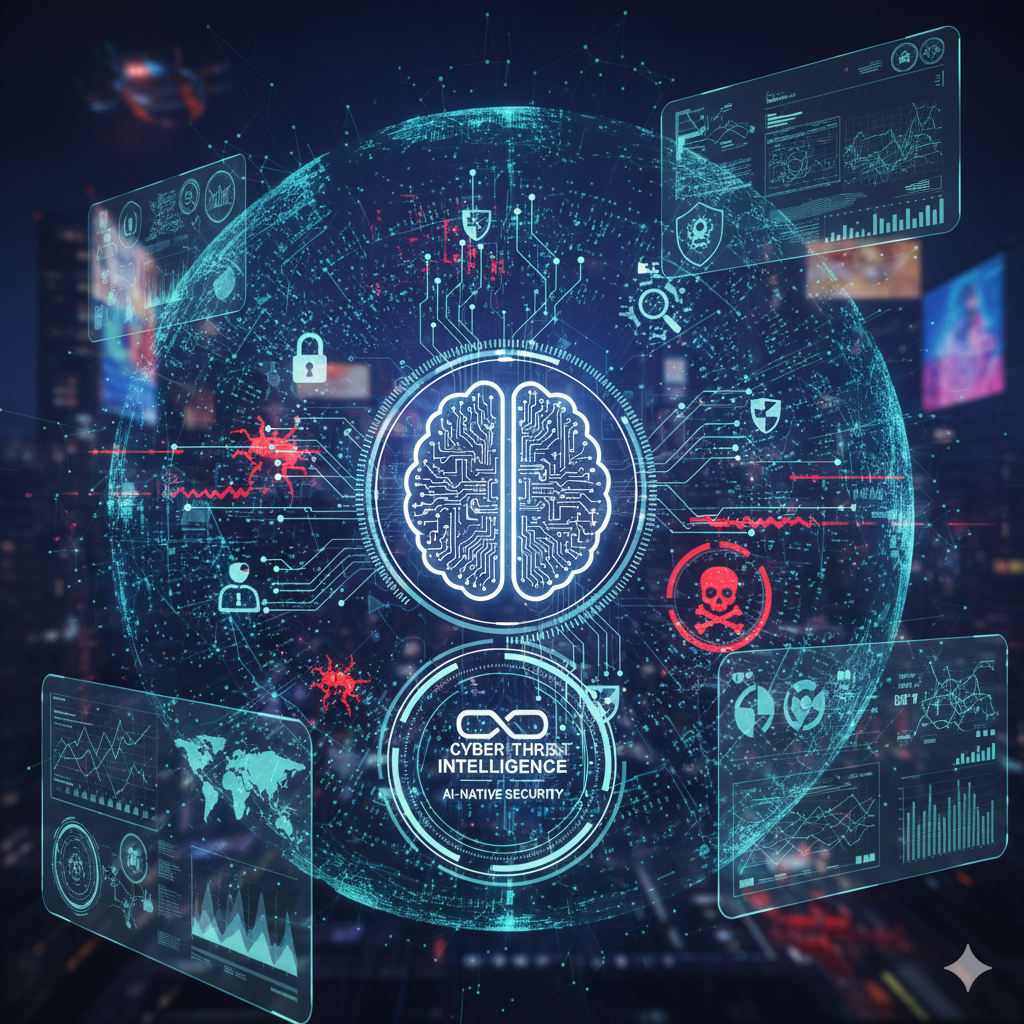
AI-native security architectures redefine enterprise defense in 2026, where every component from endpoints to cloud workloads embeds autonomous AI capable of real-time threat response. Cyber Threat Intelligence (CTI) becomes the neural network's lifeblood, feeding predictive adversary data into agentic systems that autonomously hunt, adapt, and neutralize attacks at machine speed. As AI agents proliferate, handling 70% of business workflows, attackers target them directly with prompt injections, data poisoning, and identity hijacking, projecting $12 trillion in global cyber losses. Traditional CTI falls short AI-native fusion delivers TTP-enriched models that evolve defenses dynamically. Business leaders face dual pressures: accelerating AI adoption for a competitive edge while securing agent swarms against novel exploits. Boards demand CTI-backed governance proving agent safety under EU AI Act expansions and NIST frameworks, with non-compliance risking multimillion-dollar fines. Organizations mastering this integration achieve 80% dwell time reduction, automated compliance, and cyber insurance discounts, transforming security from bottleneck to accelerator. 2025 proved the concept: firms with AI-native CTI blocked 90% of agent-targeted attacks via behavioral baselines fused with dark web signals, at Informatix.Systems, we provide cutting-edge AI, Cloud, and DevOps solutions for enterprise digital transformation, engineering CTI pipelines that power native AI defenses seamlessly. This guide covers architectures, integrations, threat models, tools, and strategies for 2026 dominance.
AI-Native Security Architectures
AI-native security builds self-defending systems where ML models continuously learn from CTI feeds, adapting signatures and behaviors without human intervention.
Core Layers:
- Agentic detection engines: Autonomous anomaly hunting.
- Behavioral baselines per workload type.
- Self-healing orchestration via SOAR AI.
CTI's Role in AI Model Defense
CTI monitors training pipelines, flagging poisoned datasets and adversarial inputs before model deployment.
Protection Mechanisms
- Dark web scraping for leak signals.
- Prompt injection signature libraries.
- Agent behavior drift detection.
Agentic Threat Intelligence Fusion
AI agents ingest STIX-formatted CTI, enrich with internal telemetry, and generate hunting hypotheses autonomously.
Fusion Workflow:
- Multi-source intel ingestion.
- Graph-based relationship mapping.
- Predictive TTP simulation.
At Informatix.Systems, we provide cutting-edge AI, Cloud, and DevOps solutions for enterprise digital transformation.
MITRE ATT&CK for AI Threats
Extended ATT&CK matrices cover agent compromise techniques like tool misuse and identity spoofing.
Leading AI-Native CTI Platforms
Platforms embed CTI directly into AI runtimes.
2026 AI Threat Landscape
Expect identity as the new perimeter, with deepfake agents and shadow AI exposing IP at scale.
Emerging Vectors:
- Autonomous insider threats via hijacked agents.
- Quantum-accelerated cryptocracking.
- Supply chain AI tampering.
Building AI-CTI Data Pipelines
Stream CTI via Kafka into ML feature stores, enabling continuous model retraining.
Pipeline Steps:
- Normalized feed ingestion (STIX/TAXII).
- Vector embedding for semantic search.
- Feedback loops from detections.
Autonomous SOAR with CTI Triggers
AI playbooks activate on intel signals, chaining isolation, forensics, and remediation without alerts.
Advanced Triggers
- TTP match → workload quarantine.
- Campaign expansion → network pivots.
At Informatix.Systems, we provide cutting-edge AI, Cloud, and DevOps solutions for enterprise digital transformation.
AI-Native Success
Fintech deployed CTI-fused agents, neutralizing prompt attacks in 2 seconds vs 48 hours. Manufacturing blocked supply chain poisoning via predictive intel.
Results:
Metrics for AI-Native Maturity
Track agent accuracy (92%+), intel utilization (85%), and threat prevention ROI (6x).
Dashboards:
Governance for AI-Native CTI
Embed red-teaming in CI/CD, with CTI validating agent safety continuously.
Controls
Overcoming Integration Challenges
Latency solved via edge AI; silos via unified lakes.
Strategies:
Skills for AI-Native Teams
Master prompt engineering, graph ML, and adversarial training alongside traditional CTI.
Upskilling Path:
Supply Chain CTI for AI Ecosystems
Monitor OSS dependencies, vendor agents, and integration tampering with behavioral intel.
Regulatory Compliance in AI-Native Era
Automate EU AI Act high-risk classifications and NIST AI RMF via CTI proofs.
Scaling Global AI-Native Defenses
Geo-distributed agents with unified CTI lakes ensure consistent protection.
Future: Neuromorphic AI Security 2027
Brain-like chips enable instantaneous TTP matching at the edge scale.
Ethical AI Intelligence Practices
Transparent models, diverse training, and human veto rights prevent bias amplification.
Cyber Threat Intelligence powers AI-native security for 2026, creating autonomous fortresses that predict, adapt, and defeat agentic adversaries. Enterprises deploying fused architectures gain unbreakable resilience, operational supremacy, and compliance mastery. Fortify your AI future partner with Informatix.Systems for native implementations. Visit https://informatix.systems now for an AI-CTI architecture review.
FAQs
What defines AI-native security?
Autonomous AI components handling detection/response natively.
How does CTI protect AI models?
Monitors poisoning, injections via specialized intel branches.
Primary 2026 AI threat?
Agent hijacking via prompt exploits.
Integration complexity level?
Streamlined via STIX APIs and feature stores.
Expected ROI timeline?
6x within 6 months via automation.
Regulatory readiness?
Built-in proofs for AI Act/NIST.
Informatix.Systems expertise?
End-to-end AI-CTI deployment accelerators.
Scalability for enterprises?
Cloud-native agents scale infinitely.
No posts found
Write a review