
Cyber Threat Intelligence for AI Risk Intelligence
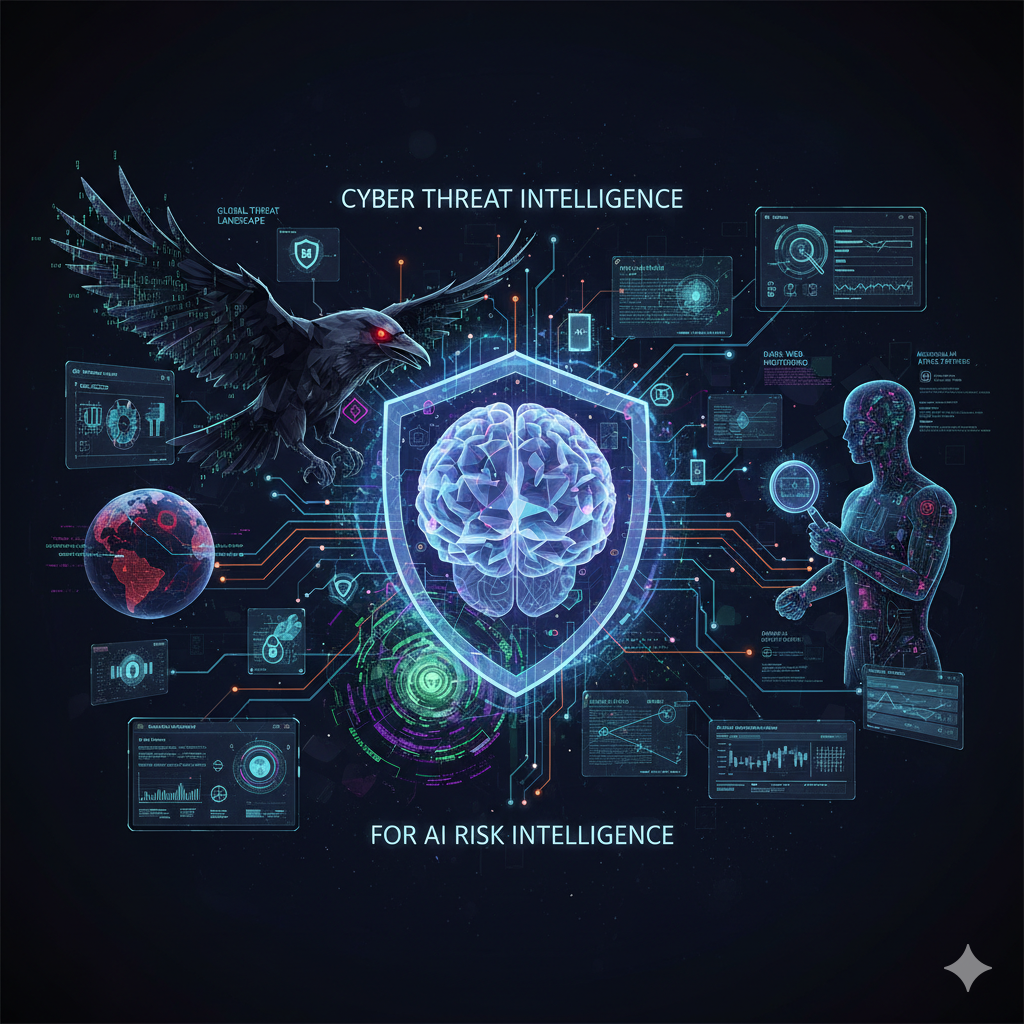
In 2026, Cyber Threat Intelligence (CTI) emerges as the critical discipline for managing AI Risk Intelligence, addressing the dual-edged sword of AI in cybersecurity. Adversaries wield agentic AI for automated attacks, model poisoning, adversarial inputs, and synthetic identity fraud, while enterprises deploy AI for defense, creating new vulnerabilities like data exfiltration from LLMs and supply chain compromises in training pipelines. CTI evolves to fuse external threat signals with internal AI telemetry, producing holistic risk scores for models, agents, and users. This intelligence layer predicts AI-specific threats, from jailbreak attempts to poisoned datasets, enabling proactive mitigation in an era where 61% of CISOs report heightened ransomware via AI automation. The business stakes are immense: AI breaches could cost trillions, disrupting operations from autonomous agents to board-level decisions. CTI for AI Risk Intelligence shifts paradigms from IOCs to TTPs, operationalizing behavioral indicators for detection engineering. Enterprises gain predictive foresight forecasting adversary progression, prioritizing exposures, and automating responses, reducing MTTR by 80% and preventing systemic failures. As AI agents proliferate, identity risk intelligence fuses corporate and personal signals, treating every AI entity as a potential attack vector, at Informatix.Systems, we provide cutting-edge AI, Cloud, and DevOps solutions for enterprise digital transformation, integrating CTI to safeguard AI ecosystems. This guide dissects CTI's application to AI risks lifecycle adaptations, platform innovations, and 2026 trends like cyber fusion centers. Leaders will discover frameworks to defend models, pipelines, and agents, ensuring AI accelerates innovation without compromise. In the AI arms race, CTI positions organizations as resilient pioneers.
Defining AI Risk Intelligence
AI Risk Intelligence encompasses threats targeting AI systems, model inversion, prompt injection, and resource exhaustion,analyzed through CTI lenses for enterprise defense.
Core AI Threat Categories
- Data Poisoning: Corrupting training sets for biased outputs.
- Adversarial Attacks: Inputs evading detection.
- Agent Exploitation: Hijacking autonomous workflows.
CTI contextualizes these via actor TTPs, evolving risk assessment.
CTI Lifecycle for AI Risks
Adapt the classic lifecycle to AI: planning prioritizes model inventories, collection scans the dark web for leaks, and analysis predicts poisoning vectors.
AI-Enhanced Phases
- Planning: Map AI assets by criticality.
- Collection: Monitor GitHub for poisoned packages, infostealer logs.
- Processing: Enrich with behavioral IoBs (Indicators of Behavior).
- Analysis: Simulate attacks via GenAI.
- Dissemination: Real-time risk scores to SOCs.
- Feedback: Post-incident model hardening.
This iteration fortifies AI against evolving threats.
Agentic AI in CTI Operations
Agentic systems autonomously collect, curate, and act on CTI, handling 80% of triage while humans focus on strategy. At Informatix.Systems, we provide cutting-edge AI, Cloud, and DevOps solutions for enterprise digital transformation, deploying agentic CTI for AI risk mastery.
Capabilities:
- Multi-Source Fusion: OSINT + internal logs.
- Privacy-Preserving Sharing: Anonymized TTP reports.
- Detection Rule Generation: Auto-Sigma/YARA from intel.
Transforms CTI from reactive to predictive.
Integrating CTI with AI Security Tools
Fuse CTI into XAI (Explainable AI) stacks, enriching SIEM with model-specific IoCs and SOAR with agent isolation playbooks.
Steps for Fusion
- Ingest AI telemetry into CTI pipelines.
- Correlate external TTPs with internal anomalies.
- Automate responses like model rollbacks.
Creates unified AI risk intelligence.
Frameworks for AI-CTI Alignment
MITRE AIS, OWASP AI, and NIST AI RMF standardize CTI for AI risks, mapping TTPs to safeguards.
Mapping Example
- Reconnaissance: Monitor API scraping.
- Exploitation: Detect prompt injections.
- Persistence: Hunt shadow models.
At Informatix.Systems, we provide cutting-edge AI, Cloud, and DevOps solutions for enterprise digital transformation, customizing these for clients.
Challenges in AI Risk CTI
Data scarcity for novel AI threats, adversarial ML evasion, and skills gaps hinder adoption.
Mitigations:
- Synthetic Data Generation: Train on simulated attacks.
- Human-AI Loops: Validate agent outputs.
- Cross-Domain Teams: Blend CTI and ML experts.
Overcome via governance frameworks.
Measuring AI-CTI Effectiveness
Track model survival rates, poisoning detection accuracy, and risk score precision.
KPIs
- Threat Coverage: % of known AI TTPs detected.
- False Positive Reduction: ML-tuned thresholds.
- ROI: Breaches averted vs. CTI costs.
Quantifies value in AI ecosystems.
CTI for Supply Chain AI Risks
Monitor upstream poisoned dependencies and downstream agent compromises via CTI feeds.
Tactics
- SBOM Intelligence: Scan manifests against threat intel.
- Vendor Risk Scoring: Fuse CTI with third-party signals.
- Runtime Validation: Behavioral checks on integrations.
Secures AI supply chains end-to-end. At Informatix.Systems, we provide cutting-edge AI, Cloud, and DevOps solutions for enterprise digital transformation.
2026 Trends: CTI Meets AI Risks
Predictive behavioral analysis, cyber fusion centers, and collective ISACs dominate.
Key Shifts:
- TTP Operationalization: Auto-rules from intel.
- Identity-AI Fusion: Risk scores for agents/users.
- Autonomous Defense: Agents preempt attacks.
Prepare for proactive paradigms.
DevSecOps with AI-CTI
Embed CTI in MLOps: pre-train scans, inference-time monitoring, and post-deploy hunts.
Pipeline Enhancements:
- CTI-gated merges.
- Model drift alerts.
- Adversarial robustness tests.
Accelerates secure AI deployment.
CTI vs. AI Threats
- Tech Firm: Cyble detected poisoned training data, averting a bias catastrophe.
- Finance: Recorded Future halted agent hijack, saving millions.
- Healthcare: Mandiant simulations prevented model inversion.
Demonstrates real-world resilience.
Building AI-CTI Teams
Combine threat analysts, AI ethicists, and detection engineers.
Skill Matrix:
- CTI Expertise: TTP modeling.
- AI Knowledge: Adversarial ML.
- Ops: Automation scripting.
Fosters innovation in risk intelligence. Cyber Threat Intelligence for AI Risk Intelligence equips enterprises to conquer 2026's agentic threats, fusing predictive intel with automated defenses for unbreakable AI security. From lifecycle adaptations to trend mastery, CTI delivers foresight and agility. Partner with Informatix.Systems for cutting-edge AI, Cloud, and DevOps solutions driving enterprise digital transformation. Claim your free AI risk assessment at https://informatix.systems now.
FAQs
What is AI Risk Intelligence?
Holistic assessment of threats to AI systems, powered by CTI for models, agents, and pipelines.
How does CTI address model poisoning?
Monitors training data sources and detects anomalies via behavioral indicators.
What role do agentic AI play in CTI?
Automate collection, analysis, and response, freeing humans for strategy.
Which platforms support AI-CTI best?
Cyble and Recorded Future excel in model and supply chain defense.
How to integrate CTI into MLOps?
Via gated pipelines, runtime monitoring, and adversarial testing.
What metrics gauge AI-CTI success?
Detection accuracy, risk score precision, and prevented incidents.
What 2026 AI-CTI challenges arise?
Adversarial evasion and data scarcity; counter with synthetics and loops.
Can CTI predict AI attacks?
No posts found
Write a review