
Cyber Threat Intelligence for Autonomous Cyber Operations
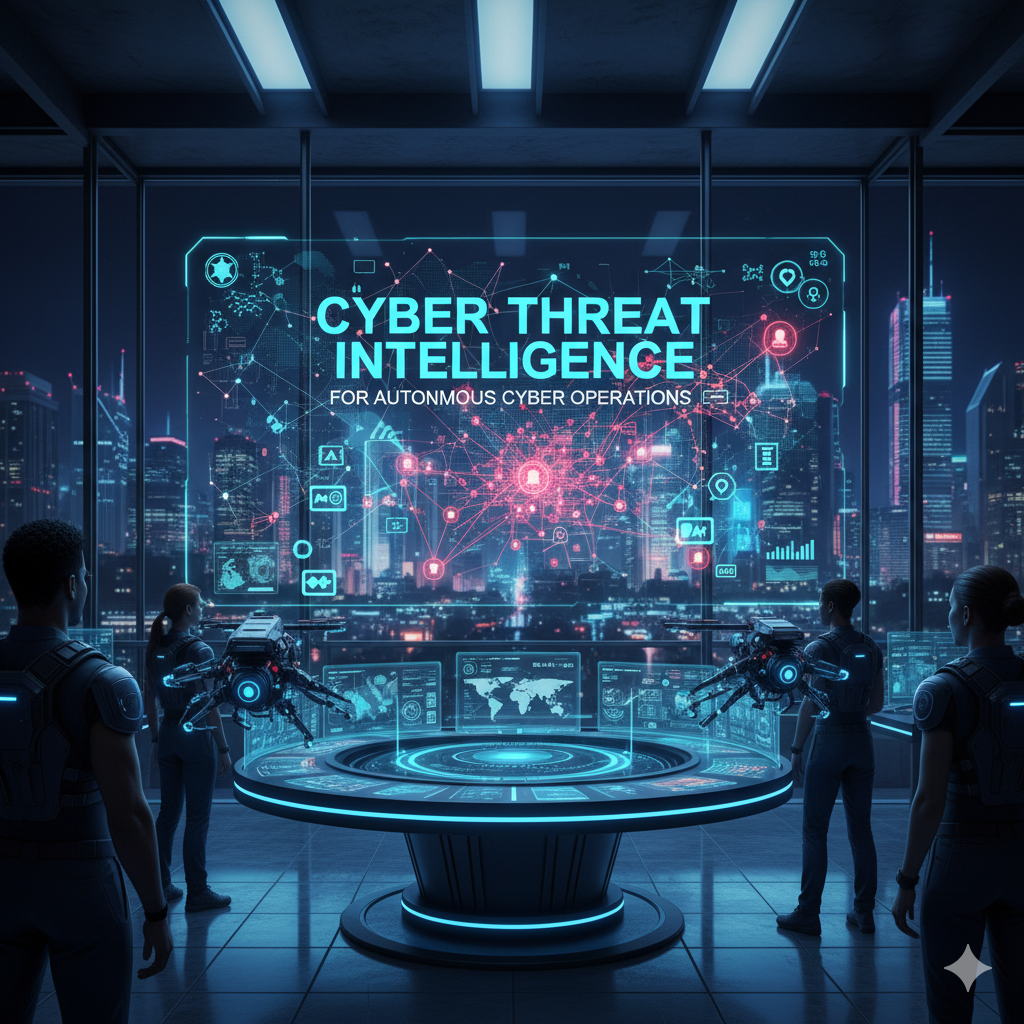
In 2026, cyber threat intelligence (CTI) powers autonomous cyber operations, transforming enterprise defenses from human-dependent SOCs into self-orchestrating ecosystems that detect, analyze, predict, and neutralize threats at machine speeds unattainable by traditional teams. Conventional CTI delivers structured insights strategic campaign landscapes, operational adversary profiling, tactical MITRE ATT&CK TTP mappings, and technical IOCs like malicious IPs and hashes but autonomous operations elevate this through agentic AI, enabling intelligence cycles to execute independently: AI agents collect from OSINT/dark web feeds, enrich via graph analytics, forecast via ML ensembles, and respond through zero-touch SOAR integrations like network isolation or dynamic patching. As attackers deploy generative AI for polymorphic ransomware, autonomous reconnaissance, and supply chain poisons—projecting $12 trillion in global losses defenders counter with self-healing networks that adapt without oversight, addressing the 4.8 million cybersecurity skills gap. Business imperatives demand this evolution: organizations achieve 90% MTTR reductions, eliminate alert fatigue, and comply with EU AI Act mandates for autonomous systems, converting security into a velocity enabler. Autonomous CTI fuses external threat signals with internal telemetry for real-time risk surfaces, powering platforms like Seceon Open XDR that independently triage, correlate, and remediate at Informatix. Systems, we provide cutting-edge AI, Cloud, and DevOps solutions for enterprise digital transformation, delivering scalable autonomous operations that turn intelligence into unbreakable resilience. This comprehensive guide details agentic frameworks, platform integrations, operational roadmaps, and 2026 trends like TTP operationalization and collective defense meshes, equipping CISOs to deploy self-defending architectures against AI-orchestrated threats.
CTI Foundations for Autonomy
Cyber threat intelligence provides the structured data backbone for autonomous operations, categorizing threats into IOCs for blocking, TTPs for behavioral modeling, and IOBs for predictive baselines that AI agents operationalize without human input.
Autonomous-Ready CTI Components
- Strategic Feeds: Campaign intent for policy generation.
- Operational Intel: Actor behaviors for emulation.
- Tactical TTPs: MITRE mappings for rule automation.
- Technical IOCs: Real-time enrichment APIs.
Enables end-to-end machine execution.
Agentic AI in Cyber Operations
Agentic AI systems—autonomous agents with reasoning, goals, and tool access—execute full CTI lifecycles: planning via risk models, collecting multi-source data, processing with NLP/ML, analyzing predictively, disseminating via dashboards, and feeding back for self-improvement.
Agent Capabilities
- Multi-Agent Orchestration: Collaborative threat hunts.
- Tool Autonomy: API calls, SOAR triggers.
- Self-Healing Logic: Patching, isolation.
Shifts teams to supervision roles.
Autonomous CTI Lifecycle
The six-phase cycle becomes zero-touch: AI plans requirements from asset inventories, collects via federated feeds, processes noise autonomously, analyzes via graph neural networks, disseminates contextually, and optimizes continuously.
Zero-Touch Phases
| Phase | Autonomous Execution | Impact |
|---|---|---|
| Collection | API/sensor fusion | 10x coverage |
| Analysis | ML TTP prediction | 85% accuracy |
| Response | SOAR automation | MTTR <60s |
Feedback loops ensure evolution.
Self-Healing Network Architectures
CTI-powered networks detect anomalies via behavioral baselines, predict propagations through attack path modeling, and execute remediations like micro-segmentation or workload migration without alerts.
Healing Mechanisms:
- Dynamic policy enforcement.
- Canary deployment automation.
- Backup restoration triggers.
Achieves 99.99% uptime targets. At Informatix.Systems, we provide cutting-edge AI, Cloud, and DevOps solutions for enterprise digital transformation.
Leading Autonomous Platforms
2026 frontrunners: Seceon Open XDR (self-learning detection), Recorded Future Autonomous Threat Ops (agentic intel), Cyware (proactive agents), Palo Alto AI firewalls. Evaluate the autonomy depth and false positive rates.
Platform Matrix
| Platform | Autonomy Level | Key Strength |
|---|---|---|
| Seceon XDR | Full lifecycle | Predictive response |
| Recorded Future | Agentic intel | TTP automation |
| Cyware | Proactive fusion | Dark web agents |
API extensibility is essential.
Metrics for Autonomous Success
Benchmark autonomy coverage (95%), prediction precision (82%), self-healing rate (90%), and human intervention (<5%). Real-time dashboards track drift.
Core KPIs:
- MTTD/MTTR compression.
- Agent uptime/reliability.
- Averted incident value.
Drives continuous refinement.
Secure Autonomous Sharing
STIX/TAXII 2.2 with blockchain provenance enables agent-to-agent intel exchange in ISACs, accelerating collective defense by 70% while preserving privacy via federated learning.
Sharing Protocols:
- Verified agent identities.
- Anonymized behavioral signals.
- Consensus-based validation.
Builds ecosystem resilience.
DevSecOps Autonomous Integration
Embed CTI agents in CI/CD pipelines for autonomous vuln prediction, code tampering detection, and policy-as-code generation. Rejects risky merges pre-deployment.
Pipeline Autonomy:
- Real-time threat ingestion.
- ML risk scoring gates.
- Auto-remediation workflows.
Boosts velocity 50% securely. At Informatix.Systems, we provide cutting-edge AI, Cloud, and DevOps solutions for enterprise digital transformation.
Countering Autonomous Adversaries
Deploy AI governance firewalls to bound agent behaviors, adversarial training against prompt injections, and zero-trust autonomy with continuous verification. CTI arms dynamic countermeasures.
Defense Stack:
- Runtime behavior bounds.
- Multi-agent swarm counters.
- Emergency kill switches.
Matches attacker speeds.
Edge and IoT Autonomous Operations
Lightweight CTI agents secure distributed edges: predicting OT disruptions, isolating compromised IoT, and federating intel upward. Essential for Industry 4.0.
Edge Capabilities:
- Local anomaly detection.
- Privacy-preserving aggregation.
- Autonomous quarantine.
Scales to billions of devices.
Regulatory Compliance in Autonomy
EU AI Act mandates auditable agent decisions; NIST frameworks guide oversight. Immutable logs prove compliance.
Skills for Autonomous Operators
Master agent orchestration, ML ops, and ethical AI governance. SANS CTI Summit certifications are critical.
Core Competencies:
Maturity Model Progression
Levels: Manual (1), Assisted (3), Autonomous (5). Phased migration via POCs.
Milestones:
Autonomy Deployments
Enterprises using Seceon neutralized ransomware autonomously (MTTR 45s); manufacturing self-healed OT intrusions. 10x ROI achieved.
Future: Hyper-Autonomous 2027
Neuromorphic agents, global intel meshes, quantum autonomy. Pioneers redefine defense. Cyber threat intelligence enables autonomous cyber operations in 2026, forging self-defending enterprises against agentic threats through agentic execution, self-healing architectures, and zero-touch lifecycles. These strategies deliver unmatched resilience and efficiency. Deploy autonomous defense with Informatix.Systems. Visit https://informatix.systems for AI, Cloud, DevOps solutions automate supremacy today.
FAQs
What powers autonomous cyber operations?
Agentic AI executing CTI lifecycles independently.
Top autonomous platforms?
Seceon XDR, Recorded Future agents.
Key success metrics?
Autonomy coverage, MTTR compression.
Secure sharing methods?
DevSecOps autonomy benefits?
Countering agentic attackers?
Governance firewalls, adversarial training.
Required skills?
Maturity levels?
No posts found
Write a review