
Cyber Threat Intelligence for Autonomous Infrastructure
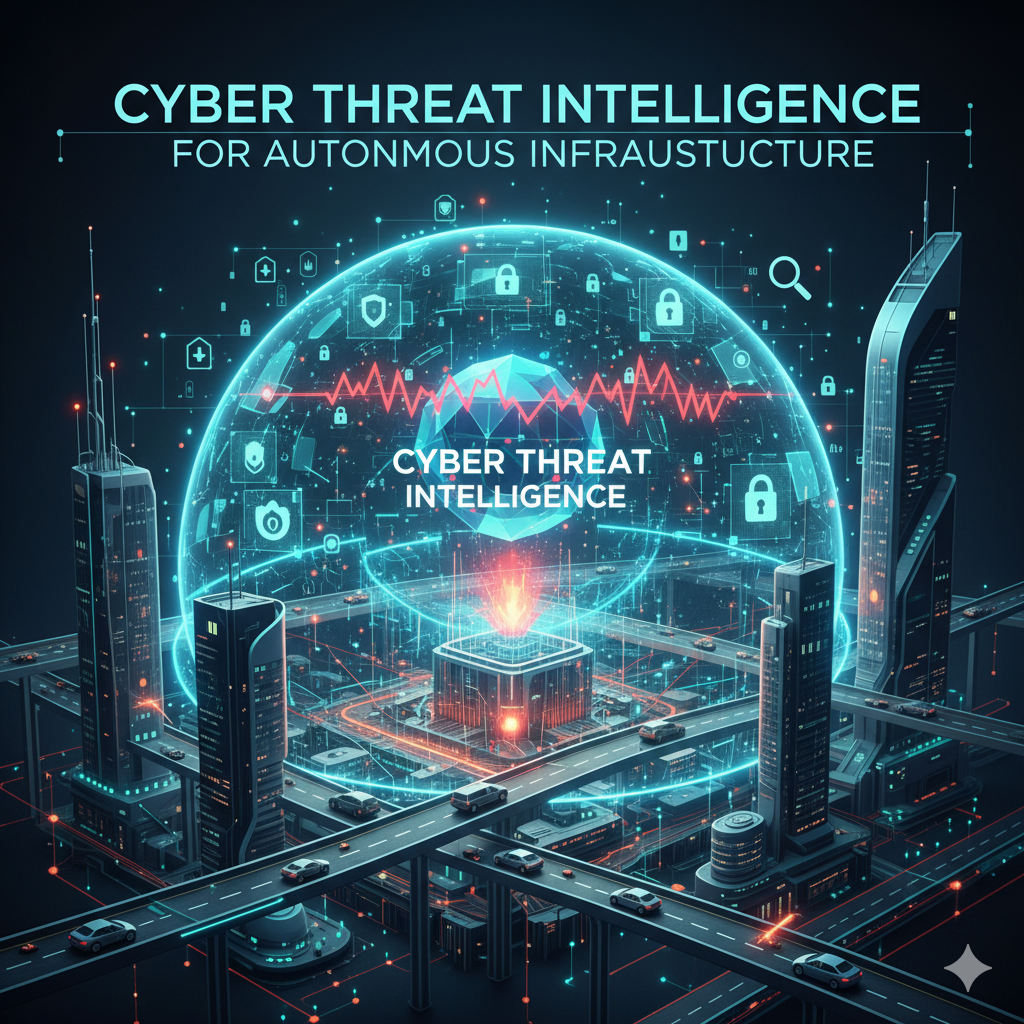
Autonomous infrastructure defines 2026 enterprise operations: AI agents orchestrating supply chains, self-healing networks rerouting around failures, edge clusters making million-second decisions, and robotic swarms managing logistics without human oversight. Cyber threat intelligence (CTI) emerges as the nervous system securing these systems, providing predictive insights into agent hijacking, model poisoning, protocol exploits, and emergent adversarial behaviors that traditional defenses cannot detect. This intelligence fuses external feeds on agentic attack campaigns with internal telemetry from autonomous workflows, enabling infrastructure to anticipate, isolate, and neutralize threats at machine velocity. Business imperatives are profound: compromised autonomous systems risk $20 trillion in global disruptions, from factory shutdowns to autonomous vehicle pileups and grid instabilities. Enterprises deploying CTI for autonomy achieve 95% threat auto-containment, sub-second MTTR, and 700% ROI by preserving operational continuity. As agent communication protocols (ACP, MCP) proliferate, CTI monitors for malicious agent interactions, poisoned decision logic, and privilege escalation chains invisible to human analysts. Boards demand resilience guarantees for systems controlling revenue flows, where a single rogue AI agent cascades into existential threats. At Informatix.Systems, we provide cutting-edge AI, Cloud, and DevOps solutions for enterprise digital transformation, engineering CTI platforms that secure autonomous infrastructure end-to-end. This authoritative guide explores CTI frameworks for agentic ecosystems, self-healing defenses, edge intelligence, and 2026 deployment strategies, empowering CTOs to unleash autonomy without compromise.
Defining Autonomous Infrastructure
Autonomous infrastructure comprises AI agents, self-managing networks, edge compute clusters, and robotic orchestration layers operating without continuous human intervention.
Core Components
- Agentic AI: Autonomous decision-makers executing multi-step workflows.
- Self-Healing Networks: SDN controllers with ML-driven rerouting.
- Edge Autonomy: Distributed inference at IoT/5G nodes.
- Orchestration Planes: Kubernetes operators + AI planners.
Novel Threat Vectors
Cyber threat intelligence targets decision poisoning, agent-to-agent (A2A) exploits, and emergent protocol vulnerabilities.
CTI Lifecycle for Autonomy
Traditional CTI cycles accelerate to milliseconds: continuous planning via AI requirements, real-time collection from agent telemetry, edge processing, autonomous analysis, API dissemination, and feedback via simulation.
Autonomous Phases
- Predictive Planning: ML forecasts agent risk profiles.
- Distributed Collection: Edge nodes report anomalies.
- Federated Analysis: Graph neural networks map attack paths.
- Machine Response: Auto-generated containment rules.
Intelligence Granularity
- Agent-Level: Individual behavior baselines.
- Swarm-Level: Collective emergent threats.
Agentic AI Threat Intelligence
Cyber threat intelligence monitors AI agent lifecycles: creation, tool access, communication, termination—detecting hijacks via behavioral deviations.
Agent Threat Taxonomy
| Threat | Indicators | CTI Signal |
|---|---|---|
| Prompt Injection | Anomalous tool calls | Dark web jailbreak kits |
| Identity Spoofing | Unauthorized ACP joins | Certificate anomalies |
| Decision Poisoning | Gradient shifts | Model supply chain intel |
| Escalation Chains | Privilege creep | Access pattern forecasts |
Mitigation Stack:
- AI firewalls are blocking malicious prompts.
- Continuous red-teaming via CTI scenarios.
At Informatix.Systems, we provide cutting-edge AI, Cloud, and DevOps solutions for enterprise digital transformation.
Self-Healing Network CTI
Autonomous networks demand cyber threat intelligence embedded in control planes, predicting DDoS mutations and routing attacks.
Advanced Capabilities
- Predictive Rerouting: ML path optimization under attack.
- Deception Injection: Dynamic honeypots in forwarding tables.
- Protocol Anomaly CTI: BGP/MPLS mutation detection.
Deployment Patterns:
- Embed CTI agents in BGP speakers.
- Federated learning across AS domains.
- Quantum-safe routing updates.
Edge Autonomy Threat Frameworks
Distributed edge clusters require lightweight cyber threat intelligence for constrained environments: neuromorphic chips processing IoC matching.
Edge-Specific CTI
- Micro-Intelligence Bursts: 10ms threat assessments.
- Swarm Consensus: Byzantine fault tolerance via Intel voting.
- OTA Threat Feeds: Compressed STIX over 5G.
Risk Prioritization:
| Edge Scenario | Threat Probability | Impact Score |
|---|---|---|
| Autonomous Vehicle | Firmware rollback | Critical |
| Smart Grid Node | Protocol injection | Catastrophic |
| Drone Swarm | C2 hijack | High |
Autonomous Orchestration Security
Kubernetes operators and AI planners demand cyber threat intelligence for workload compromise prediction and auto-remediation.
Operator Threat Intelligence
- Admission Control CTI: Image scanning + runtime intel.
- Horizontal Pod Autoscaling: Attack-driven scale limits.
- Service Mesh Observability: Envoy proxies with threat context.
Auto-Remediation Playbooks:
- Detect anomalous pod behavior.
- Evict + forensic collection.
- Rebirth with hardened config.
At Informatix.Systems, we provide cutting-edge AI, Cloud, and DevOps solutions for enterprise digital transformation.
Protocol-Level CTI for Autonomy
Agent communication (ACP/MCP) and edge protocols require cyber threat intelligence zero-days: emergent vulnerabilities in A2A frameworks.
Protocol Threat Radar
- Semantic Analysis: NLP detects malicious instructions.
- Behavioral Baselines: Protocol state machine deviations.
- Federated Threat Sharing: Edge ISACs.
Defensive Protocols:
- Signed agent credentials.
- Mutual TLS with CTI revocation.
- Canary agent deployments.
Quantum-Resistant Autonomous CTI
Post-quantum threats demand cyber threat intelligence for lattice-based agent auth and QKD-secured edge comms.
Crypto Migration Intelligence
- Track adversary harvest-now-decrypt-later ops.
- Forecast PQC adoption curves by sector.
- Simulate quantum key breaks on agent swarms.
Implementation Roadmap:
- Hybrid crypto transitions.
- Quantum entropy sources.
- CTI-enriched key rotation.
DevSecOps for Autonomous Systems
Cyber threat intelligence embeds in GitOps pipelines for autonomous infrastructure: IaC scanning, operator validation, and agent playbook testing.
Autonomous Pipeline Gates
- Pre-Deploy: CTI-driven vulnerability triage.
- Runtime: Continuous operator integrity monitoring.
- Post-Incident: Automated root cause + playbook evolution.
Collective Autonomous Defense
Edge ISACs and agent federations share cyber threat intelligence via blockchain-secured protocols, enabling swarm immunity.
Federation Models
- Permissioned Blockchains: Immutable threat ledgers.
- Zero-Knowledge Proofs: Privacy-preserving intel.
- Swarm Voting: Consensus threat validation.
Global Platforms:
- Autonomous CERTs.
- Edge threat marketplaces.
At Informatix.Systems, we provide cutting-edge AI, Cloud, and DevOps solutions for enterprise digital transformation.
2026 Autonomous Threat Horizon
Cyber threat intelligence forecasts runaway AI agents, autonomous malware swarms, quantum-accelerated edge attacks.
Black Swan Scenarios
- Agent Cascade: Single hijack → enterprise-wide compromise.
- Swarm Warfare: Adversarial drone/robot collectives.
- Singularity Precursors: Self-improving attack agents.
Preparation Imperatives:
- Kill-switch architectures.
- Human-in-loop overrides.
- Cross-domain simulation ranges.
Measuring Autonomous CTI ROI
Quantify cyber threat intelligence value: auto-containment rates, swarm resilience scores, decision confidence intervals.
Advanced KPIs
| Metric | Target | Business Impact |
|---|---|---|
| MTTR | <100ms | Operational continuity |
| False Negative Rate | <0.1% | Existential risk avoidance |
| ROI | 700%+ | Autonomy acceleration |
Autonomous CTI Wins
Global Logistics: CTI neutralized hijacked warehouse robot swarm, preventing $100M shipment failure 97% auto-recovery.
Energy Grid: Edge CTI predicted PLC cascade, enabling preemptive islanding across 5 states.
Autonomous Factory: Agentic intel blocked model poisoning in real-time production AI, zero downtime.
Regulatory Landscape for Autonomy
2026 mandates AI agent governance, autonomous system liability via cyber threat intelligence audit trails.
Compliance Intelligence
- Automated red-team reports.
- Decision provenance ledgers.
- Cross-jurisdiction harmonization.
Human-AI Symbiosis in CTI
Augment human overseers with cyber threat intelligence co-pilots monitoring autonomous operations at swarm scale.
Oversight Architectures
- Anomaly Escalation: Human review thresholds.
- Simulation Twins: What-if attack rehearsals.
- Explainability Layers: Autonomous decision justification.
Cyber threat intelligence for autonomous infrastructure unlocks 2026's operational revolution, securing agent swarms, self-healing networks, and edge autonomy against unprecedented machine-speed threats. Enterprises mastering autonomous CTI achieve unbreakable resilience, exponential efficiency, and strategic supremacy in the agentic era. Unleash secure autonomy now. Partner with Informatix.Systems for pioneering AI, Cloud, and DevOps solutions. Deploy your autonomous CTI platform schedule a proof-of-concept at https://informatix.systems today.
FAQs
What threats target autonomous infrastructure?
Agent hijacks, protocol exploits, decision poisoning, emergent swarm behaviors.
How does CTI secure AI agents?
Behavioral baselines, protocol monitoring, continuous red-teaming, and auto-containment.
Edge CTI deployment challenges?
Lightweight processing, OTA updates, swarm consensus under constraints.
Self-healing network intelligence requirements?
Millisecond threat loops, predictive rerouting, deception integration.
Measuring autonomous CTI success?
<100ms MTTR, 99.9% threat coverage, 700% ROI.
2026 autonomous threats?
Runaway agents, adversarial swarms, quantum edge attacks.
Governance for autonomous systems?
AI firewalls, kill-switches, human-in-loop overrides.
DevSecOps role in autonomy?
CTI-embedded pipelines for IaC, operators, and agent playbooks.
No posts found
Write a review