
Cyber Threat Intelligence for Intelligent Threat Forecasting
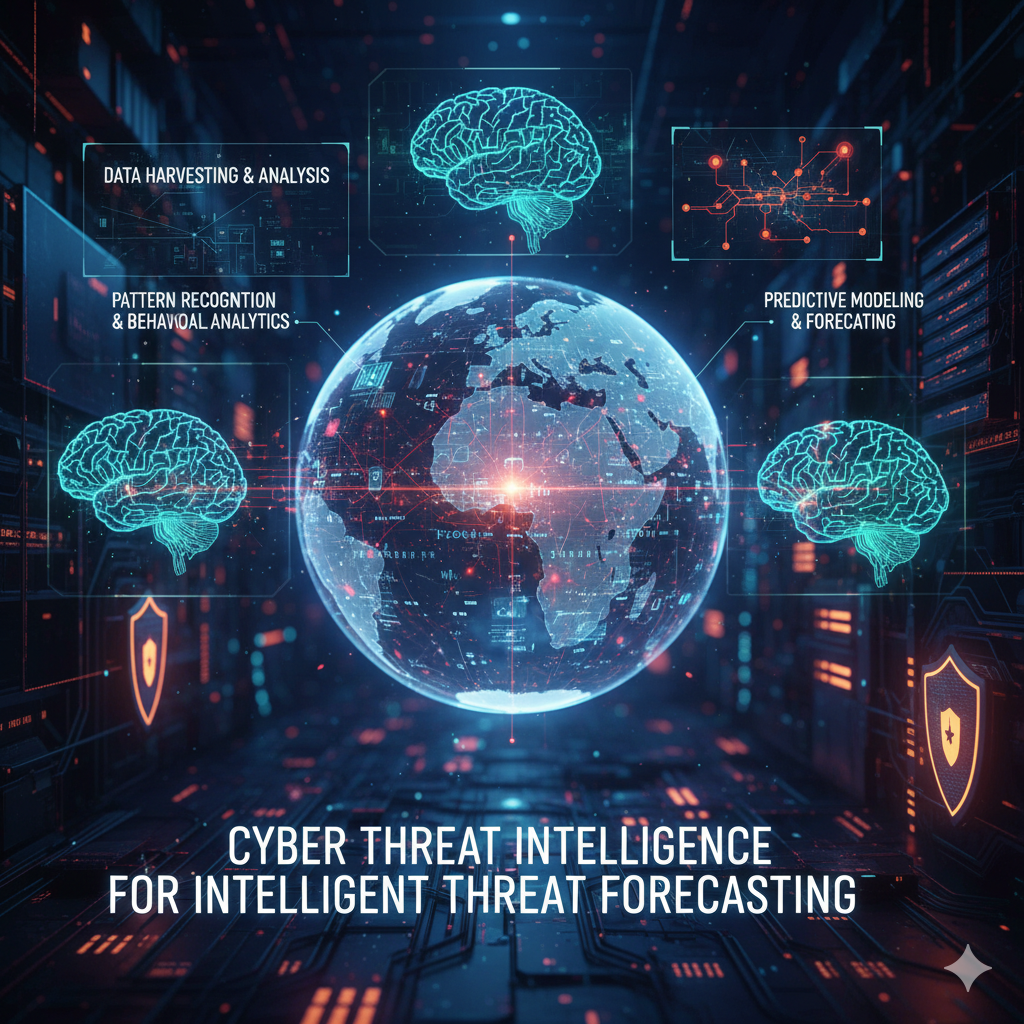
In 2026, cyber threat intelligence (CTI) ascends to intelligent threat forecasting, empowering enterprises to transcend reactive defenses and embrace prescient security architectures amid an AI-amplified threat landscape. Traditional CTI delivers contextualized insights into adversary tactics, techniques, and procedures (TTPs), indicators of compromise (IOCs), and campaign dynamics. Still, intelligent forecasting harnesses machine learning (ML), graph analytics, and time-series modeling to predict attack vectors before execution analyzing dark web signals, geopolitical tensions, and behavioral anomalies to forecast ransomware surges, nation-state espionage, or supply chain compromises. With autonomous AI agents scaling attacks at machine speeds, global cybercrime costs projected to eclipse $10.5 trillion, and dwell times compressing under predictive pressures, organizations face unprecedented imperatives to operationalize foresight. Sectors like finance, healthcare, and critical infrastructure bear the brunt, where unforecasted threats erode trust, inflate remediation costs, and invite regulatory scrutiny. The business rationale is compelling: CISOs leveraging intelligent CTI achieve 60-80% reductions in mean time to detect (MTTD), optimize $100M+ security budgets via prioritized mitigations, and align defenses with revenue-critical assets. As adversaries embed generative AI into phishing, malware polymorphism, and prompt injection, forecasting shifts from descriptive analytics to probabilistic modeling fusing external intelligence feeds with internal telemetry to deliver hyper-accurate predictions. At Informatix.Systems, we provide cutting-edge AI, Cloud, and DevOps solutions for enterprise digital transformation, delivering platforms that transform raw CTI into actionable forecasts, enabling autonomous responses and board-level risk narratives. This exhaustive guide unpacks methodologies, tools, integration blueprints, and 2026 trends like agentic AI arms races and identity threat detection/response (ITDR), equipping security leaders to forge unbreakable, foresight-driven postures against tomorrow's threats.
CTI Foundations for Forecasting
Cyber threat intelligence systematically aggregates, processes, and analyzes threat data to yield strategic, operational, tactical, and technical insights, forming the bedrock for intelligent forecasting. It distinguishes IOCs (ephemeral artifacts) from TTPs (persistent behaviors) and emerging indicators of behavior (IOBs), enabling models to project adversary evolution. Forecasting elevates CTI by quantifying probabilities—e.g., 75% likelihood of LockBit variant targeting healthcare within 90 days.
Forecasting-Ready CTI Tiers
- Strategic: Geopolitical risk horizons for executives.
- Operational: Campaign trajectory predictions.
- Tactical: TTP mutation forecasts via MITRE ATT&CK.
- Technical: IOC decay modeling for proactive blocking.
High-fidelity CTI feeds ML pipelines, slashing false positives by 70%.
Intelligent Threat Forecasting Mechanics
Intelligent forecasting deploys AI/ML to simulate attack paths, leveraging graph neural networks for actor-infrastructure mapping, NLP for dark web sentiment, and Bayesian inference for risk scoring. Unlike static CTI, it generates dynamic forecasts e.g., predicting phishing spikes from credential leaks. 2026 sees agentic models self-refining predictions via feedback loops.
Core Forecasting Algorithms
- Time-Series Analysis: ARIMA/LSTM for attack volume trends.
- Graph Analytics: Neo4j for relationship forecasting.
- Ensemble ML: XGBoost for multi-signal fusion.
Accuracy targets: 80%+ hit rates on validated predictions.
CTI Lifecycle with Forecasting Integration
The six-phase cycle—planning, collection, processing, analysis, dissemination, feedback—infuses intelligence at analysis via predictive layers. AI automates collection from OSINT APIs, enriches with geospatial data, and disseminates via probabilistic dashboards.
Forecasting-Enhanced Phases
Iterative refinement yields compounding precision.
2026 Forecasting Trends
Agentic AI dominates: autonomous forecasters predict TTP shifts, GenAI phishing evolutions, and prompt injection campaigns. Trends encompass continuous threat exposure management (CTEM), MITRE CTID for intent modeling, and fused identity risk scoring. Quantum threats demand hybrid classical-quantum forecasts.
Pivotal Trends:
- Predictive Fusion: CTI + vuln intel.
- Behavioral Forecasting: IOBs over IOCs.
- Collective Prediction: Shared ML models.
At Informatix.Systems, we provide cutting-edge AI, Cloud, and DevOps solutions for enterprise digital transformation.
Architecting Forecasting Programs
Initiate with maturity audits, defining KPIs like prediction ROI. Scale via cross-functional centers of excellence (CoEs), budgeting 7-12% of SecOps. Phased rollout: pilot high-risk vectors, expand enterprise-wide.
Program Blueprint
- Requirements Mapping: Business-aligned threats.
- Data Pipeline Build: Multi-source ingestion.
- Model Deployment: Cloud ML ops.
- Governance Layer: Ethical forecasting controls.
Premier Forecasting Platforms
2026 frontrunners: Cyble Vision (OSINT prediction), Recorded Future (temporal analytics), Mandiant (actor forecasting), Darktrace (autonomous ML). Criteria: backtest accuracy, API velocity, MITRE coverage.
Platform Evaluation Matrix
| Platform | Forecasting Strength | Integration Depth |
|---|---|---|
| Recorded Future | Temporal risk scoring | SIEM/SOAR |
| Cyble | Dark web prediction | Cloud-native |
| Darktrace | Anomaly forecasting | EDR/XDR |
Hybrid stacks optimize coverage.
KPIs for Forecasting Efficacy
Benchmark forecast accuracy (80%+), actionable rate (90%), averted loss value, and model drift (<5%). Quarterly backtesting validates against incidents.
Critical Metrics:
- Hit Rate: Predicted vs. realized threats.
- Precision/Recall: Balanced alerting.
- Business ROI: $/prediction.
Automated dashboards track evolution.
Collaborative Forecasting Ecosystems
STIX 2.2/TAXII enables federated forecasting, with ISACs sharing probabilistic models. Best practices: differential privacy, trust scoring, automated validation—boosting collective accuracy 50%.
Ecosystem Protocols:
- Model Federation: Privacy-preserving training.
- Signal Exchange: Anonymized IOBs.
- Dispute Resolution: Consensus algorithms.
Forecasting Triumphs
A multinational bank forecasted a nation-state APT, preempting $200M breach; retailers predicted holiday ransomware via leak signals. Energy firms modeled OT disruptions, averting outages. Common thread: 4-7x ROI.
Extracted Lessons:
- Domain-Specific Tuning: Sector models outperform generics.
- Human-AI Symbiosis: Overrides refine baselines.
DevSecOps Forecasting Embedment
Infuse predictions into CI/CD: forecast vuln exploits pre-merge, auto-scan for leaked secrets, enforce policy via ML gates. Reduces escapees 70%, accelerates velocity.
Embedment Steps:
- Feed Streaming: Kafka for real-time CTI.
- Pipeline Oracles: Prediction-as-a-service.
- Auto-Remediation: GitOps heals.
At Informatix.Systems, we provide cutting-edge AI, Cloud, and DevOps solutions for enterprise digital transformation.
Competencies for Forecasting Leaders
Proficiency in ML ops, Bayesian stats, MITRE CTID, cloud ML platforms. Strategic: forecast-to-board translation. Certifications: GCTI, Certified ML Engineer.
Expertise Framework:
- Quantitative: Prophet/LightGBM mastery.
- Domain: Threat ontology design.
- Communicative: Probabilistic narratives.
Maturity Continuum for Programs
Gartner-inspired: Level 1 (descriptive CTI), Level 3 (predictive pilots), Level 5 (prescriptive autonomy). Annual assessments guide investments.
Level Milestones:
Mitigating Forecasting Pitfalls
Address overfitting, data bias, black swan blindness via ensemble diversity, adversarial training, scenario planning. Governance ensures explainability.
Risk Mitigations:
- Diversity Mandates: Multi-vendor signals.
- Stress Testing: Synthetic crises.
- Auditability: SHAP/LIME interpretability.
Regulatory Imperatives in Forecasting
GDPR/EU AI Act demand transparent models; NIST forecasting guidelines enforce validation. Compliance elevates trust, unlocks funding.
Vendor Synergies and Roadmaps
POC rigorously; favor API-first platforms. MSSP hybrids accelerate maturity.
2027 Forecasting Frontiers
Neuromorphic acceleration, quantum ML hybrids, global forecast meshes. Visionaries claim dominance. Cyber threat intelligence for intelligent threat forecasting redefines 2026 security as a probabilistic science, preempting AI-scaled adversaries through ML precision, lifecycle infusion, and ecosystem collaboration. These frameworks deliver resilience, efficiency, and strategic supremacy. Harness forecasting supremacy with Informatix.Systems. Engage at https://informatix.systems for AI, Cloud, DevOps mastery forecast victory today.
FAQs
What defines intelligent threat forecasting in CTI?
AI/ML-driven prediction of threats via patterns, surpassing descriptive intel.
Key algorithms for CTI forecasting?
LSTM, graph NNs, Bayesian models for probabilistic outputs.
Top 2026 forecasting platforms?
Recorded Future, Cyble Vision, Darktrace.
Essential forecasting KPIs?
Accuracy, hit rate, and ROI from averts.
Sharing protocols for forecasts?
Federated STIX with privacy tech.
Forecasting in DevSecOps?
Preemptive pipeline gates and scans.
Leader skills for forecasting?
ML stats, MITRE, explainable AI.
Forecasting challenges?
No posts found
Write a review