
Voice & Chat AI Assistants for Healthcare in 2026 | Informatix.Systems
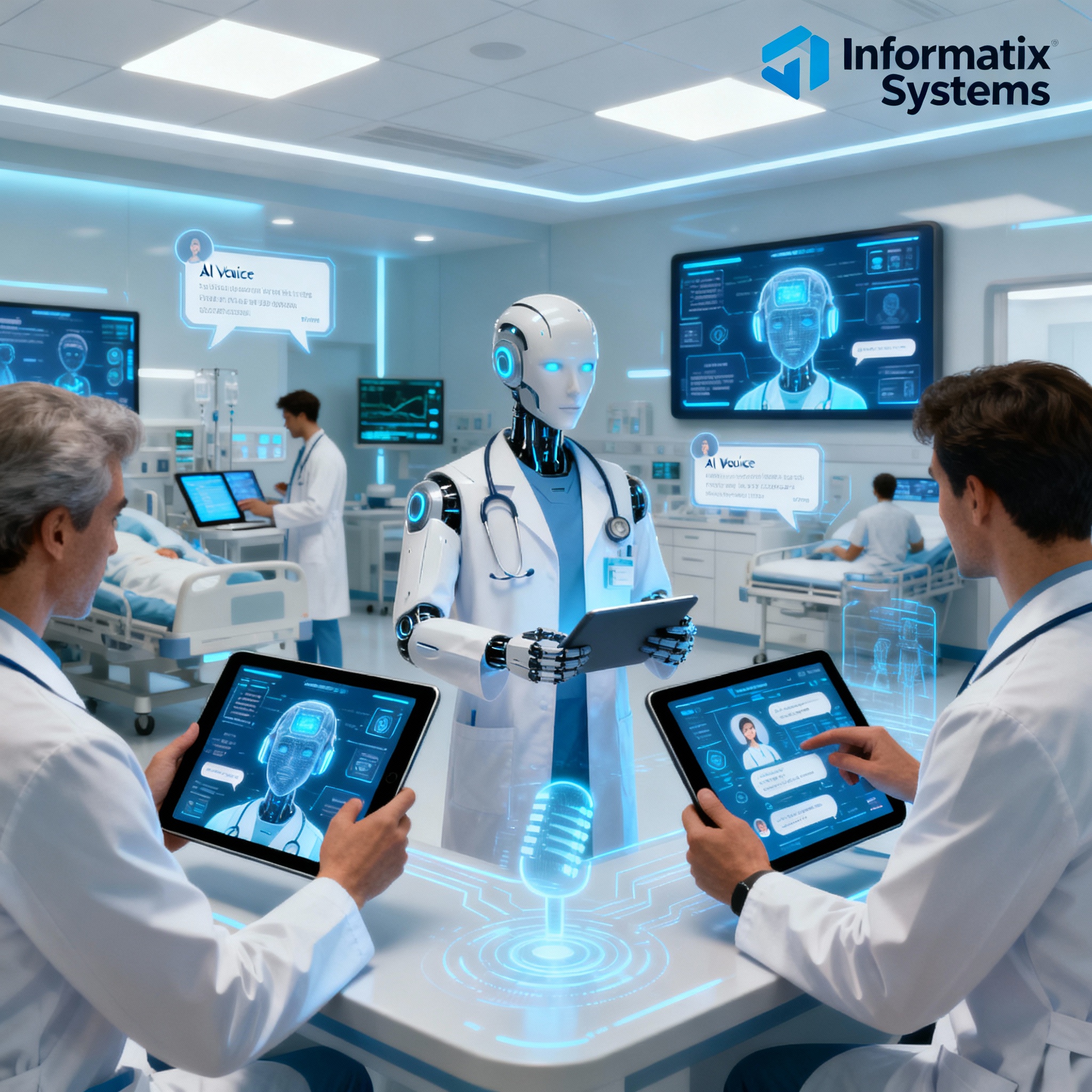
In 2026, artificial intelligence stands at the center of healthcare transformation. The rise of voice and chat AI assistants has revolutionized how patients, doctors, and healthcare organizations communicate, schedule, and manage treatment experiences. As digital ecosystems expand post-pandemic, the healthcare sector faces mounting pressure to enhance accessibility, reduce administrative overhead, and deliver personalized care 24/7. Conversational AI is the bridge connecting data, people, and outcomes with unmatched precision. By combining speech recognition, natural language processing (NLP), and machine learning, AI assistants now facilitate symptom triage, appointment scheduling, patient onboarding, medication reminders, and real-time health education. Hospitals and clinics worldwide leverage these smart systems to complement overworked staff, cut operational expenses, and improve patient satisfaction scores. Healthcare automation has entered a new frontier—one dominated by hybrid intelligence, where human compassion meets machine accuracy. Patients value immediate communication through voice commands and chatbots, while physicians depend on AI’s analytical support for diagnosis assistance and treatment adherence monitoring. At Informatix.Systems, we provide cutting-edge AI, Cloud, and DevOps solutions for enterprise digital transformation, empowering healthcare networks to build secure, compliant, and context-aware conversational systems. Our AI assistant platforms enable seamless interactions across web, mobile, and IoT channels, ensuring precision, empathy, and compliance at scale. This comprehensive article explores the evolution, application, and benefits of Voice & Chat AI Assistants in Healthcare for 2026, offering insights on how Informatix.Systems innovations are shaping the next generation of intelligent medical communication.
The Evolution of Conversational AI in Healthcare
From Reactive Systems to Proactive Intelligence
Early chatbots handled basic queries. The new era of AI healthcare assistants integrates predictive analytics and contextual intelligence to understand, learn, and respond in real time.
Key Technological Shifts:
- AI + NLP integration: Enables natural, human-like communication.
- Voice synthesis & recognition: Enhances accessibility for visually or physically impaired patients.
- Advanced neural networks: Improve multilingual and emotional context understanding.
- Omnichannel deployment: Voice/text assistants embedded in EHR, apps, and hospital kiosks.
At Informatix.Systems, our advanced AI models converge machine learning, speech AI, and cloud optimization—empowering healthcare systems to automate tasks once confined to human operators.
Why Healthcare Needs Conversational AI in 2026
Addressing the Modern Healthcare Gap
Healthcare organizations face a triad of pressures: staffing shortages, patient expectations for immediacy, and rising digital competition.
Challenges Solved by Voice & Chat AI Assistants:
- 24/7 patient interaction beyond physical clinical hours.
- Automated triage streamlining calls and routine consultations.
- Frictionless appointment management reduces administrative load.
- Multilingual communication support improves accessibility.
Through Informatix.Systems AI automation solutions, hospitals elevate patient engagement while optimizing workforce productivity.
Core Applications of Voice & Chat AI Assistants
Patient-Centric Applications:
- Symptom checker bots: Provide initial assessments using conversational inputs.
- Wellness tracking: Automated reminders for medication or exercise.
- Virtual receptionist: Manage bookings and cancellation requests.
- Teleconsultation support: AI pre-screens patient data before appointments.
Staff & Institutional Applications:
- Documentation assistance for clinicians.
- Voice-driven EHR data entry.
- Automated FAQs for billing and insurance claims.
- Compliance and audit tracking with conversational reporting tools.
At Informatix.Systems, we build AI voice ecosystems tailored to hospital workflows, ensuring medical-grade accuracy and HIPAA-aligned security.
How Voice AI is Shaping Modern Healthcare
Voice technology eliminates friction in healthcare communication. With natural speech interfaces, patients interact intuitively, bridging generational and educational gaps.
Use Cases:
- Smart clinics with voice-enabled kiosks.
- Remote patient monitoring via voice-activated devices.
- Hands-free clinician interaction during high-stress procedures.
- Elderly care and accessibility for non-tech-savvy patients.
Informatix.Systems Voice AI frameworks integrate with healthcare IoT devices for monitoring vital signs, communicating updates, and initiating emergency alerts seamlessly.
Chatbots and Virtual Health Advisors for Patient Engagement
Engaged patients are healthier and more loyal. Chatbots deliver round-the-clock availability and consistency that healthcare professionals rely on.
Benefits of AI Virtual Health Advisors:
- Improved patient literacy through simplified education.
- Real-time data collection for preventive diagnostics.
- Reduced appointment backlog through automated follow-ups.
- Continuous emotional support through personalized chat interfaces.
With Informatix.Systems conversational engines, hospitals can address thousands of inquiries predictively and empathetically, ensuring no call or message goes unanswered.
Integration with Electronic Health Records (EHR)
Seamless system synergy underpins smarter automation.
Integration Benefits:
- Unified patient data access for physicians and AI assistants.
- Context-based conversations personalized by patient history.
- Automated creation of progress notes within the EHR system.
- Secure interoperability through APIs and cloud-native DevOps pipelines.
At Informatix.Systems, our AI assistants connect with leading EHR systems, digitizing patient interactions and improving clinical documentation accuracy by up to 40%.
Cloud and DevOps Infrastructure for Scalable AI Healthcare
Cloud computing provides the backbone for AI assistants in healthcare. Scalability, uptime, and compliance are mission-critical.
Cloud Architecture Benefits:
- Elastic resource allocation for real-time voice/chat loads.
- Active/Passive failover assurance for critical applications.
- Secured HIPAA-compliant data storage.
- Global accessibility for multinational hospital networks.
Informatix.Systems Cloud and DevOps services enable healthcare organizations to deploy conversational AI at enterprise scale with 99.9% uptime and zero compromise on security.
AI Security & Compliance in Conversational Systems
Protecting sensitive medical data is non-negotiable.
Key Security Layers:
- Data encryption at transit and rest.
- Biometric voice authentication for patient verification.
- AI anomaly detection for fraud and intrusion.
- Dynamic consent management for voice-recorded sessions.
Informatix.Systems DevSecOps framework builds compliance directly into AI assistant infrastructure, ensuring adherence to HIPAA, GDPR, and ISO 27001 standards.
Predictive Analytics and Patient Outcome Enhancement
Conversational AI isn’t just communicative, it’s analytical. Every interaction delivers data for proactive decision-making.
Capabilities:
- AI-driven predictive health alerts based on symptom patterns.
- Diagnostic recommendations from aggregated conversational data.
- Treatment adherence tracking leveraging feedback monitoring.
- Population health analytics are used for large-scale trend identification.
Through Informatix.Systems predictive analytics, healthcare providers can identify at-risk groups early and optimize public health strategies with data-backed foresight.
Accessibility and Multilingual Support
AI assistants increase inclusivity by bridging linguistic and physical barriers.
Capabilities:
- Multilingual chat interactions in 120+ global languages.
- Text-to-speech and speech-to-text support for patients with limited literacy.
- Accessibility compliance for vision-impaired patients.
- Voice-enabled education tailored for rural telehealth services.
Informatix.Systems Language Intelligence Cloud ensures every voice or chat interaction remains inclusive, efficient, and contextually precise, irrespective of region or accent.
Benefits for Healthcare Institutions
Tangible Advantages:
- 40% reduction in administrative workload.
- 30% improvement in consultation throughput.
- Enhanced patient engagement and satisfaction.
- Lower operational costs through automation.
At Informatix.Systems, we measure success by real-world outcomes. Our AI healthcare assistants translate technology investments into measurable efficiency, scalability, and trust.
Future Trends: AI Healthcare Assistants Beyond 2026
The evolution continues as next-generation conversational AI integrates with digital twins, edge computing, and bio-intelligence systems.
Upcoming Innovations:
- Emotion-aware AI detecting stress and sentiment through voice tone.
- Quantum AI models for faster, more accurate diagnostics.
- Edge voice assistants for offline medical applications.
- Digital twin patients linked to personal AI avatars for continuous virtual care.
Informatix.Systems R&D division is pioneering adaptive AI architectures, ensuring our healthcare partners remain future-ready in an evolving digital health landscape.
Implementation Challenges and Informatix.Systems Solutions
Challenges:
- Managing data privacy and HIPAA compliance.
- Integrating diverse legacy hospital IT systems.
- Handling large-scale conversational data efficiently.
- Maintaining empathy while automating communication.
Informatix.Systems Solutions:
- AI governance frameworks ensure ethical automation.
- API-based integration connecting to any existing infrastructure.
- Hybrid cloud orchestration for resource optimization.
- AI training models incorporating empathy and tone modulation.
Business Value and ROI from Conversational AI
Beyond healthcare improvements, financial and operational returns underscore the strategic value of AI assistants.
Key ROI Metrics:
- Decrease in patient query handling time.
- Faster registration and billing cycles.
- Improved staff availability for critical care.
- Enhanced patient loyalty and brand trust.
Hospitals adopting Informatix. Systems Conversational AI reports ROI improvements exceeding 300% within their first operational year. The year 2026 marks a turning point for global healthcare ecosystems. Voice and chat AI assistants have evolved into trusted digital companions capable of serving patients and professionals with intelligence, reliability, and empathy. They signify a healthcare revolutionone that enhances service delivery while humanizing technology. At Informatix.Systems, we empower healthcare providers with AI-powered conversational platforms, secure cloud deployment, and DevOps precision, transforming medical operations from reactive to predictive, from manual to automated, and from transactional to truly personal. Ready to elevate patient engagement and operational performance?Partner with Informatix.Systems today to deploy next-generation Voice & Chat AI Assistants that redefine the standard of healthcare excellence for 2026 and beyond.
FAQs
What are Voice & Chat AI Assistants in healthcare?
They are AI-driven conversational systems that help manage patient communication, scheduling, and health queries through voice or chat interfaces.
How does Informatix.Systems support healthcare AI automation?
We develop AI, Cloud, and DevOps-based voice/chat systems integrating seamlessly with hospital workflows, EHR systems, and compliance frameworks.
Are healthcare AI assistants secure?
Yes, our AI solutions follow HIPAA, SOC 2, and GDPR standards using encryption, authentication, and DevSecOps-based design for safety.
Can AI assistants replace human staff?
No. They complement human care teams by automating routine tasks, allowing clinicians to focus on complex, empathetic interactions.
How do patients benefit from chatbots and voice assistants?
They enjoy 24/7 support, faster access to care information, multilingual communication, and improved appointment and prescription tracking.
What technologies power Informatix.Systems AI platforms?
Advanced NLP, machine learning, cloud infrastructure, and DevOps pipelines power our conversational healthcare automation.
What ROI can hospitals expect from adopting AI assistants?
Healthcare institutions typically experience up to 40% operational cost savings and a major boost in patient satisfaction levels.
What will the future of conversational AI in healthcare look like?
Expect deeper emotional intelligence, voice biometrics, real-time analytics, and integration with wearable health IoT ecosystems.
No posts found
Write a review