
 Solutions
 Cyber Security
 Cloud Security
 DevSecOps Automation
 Cyber Threat Intelligence
 AI & MLOps Integration
 Security Operations
 Incident Response & Forensics
 Services
 Cloud Architecture & Migration
 Zero Trust & IAM Solutions
 SOC-as-a-Service
 Threat Detection & Response
 DevOps Infrastructure Design
 Penetration Testing & Red Teaming
 AI-Driven Security Analytics
 Industries
 FinTech Cybersecurity
 Healthcare Cybersecurity
 E-Commerce Security
 Government & Defense Security
 Telecom & IoT Security
 Managed Security Services
 24×7 Managed SOC
 Managed SIEM & SOAR
 Endpoint Detection & Response
 Vulnerability Management
 Cloud & App Security Monitoring
 Compliance Management
 AI Security Lab
 AI-Driven Threat Defense
 Neural SOC Platform
 Predictive Attack Modeling
 Security Data Lake
 Research & AI Lab
 Threat Intelligence Reports
 AI Security Models
 Machine Learning for Cyber Defense
 Open-Source Tools
 Publications & Whitepapers
 AI Innovation Center
 AI Research & Development
 Generative Security Models
 Autonomous Threat Simulation
 LLM Security Framework
 Future Technology Roadmaps
 Global Threat Observatory
 Global Cyber Threat Map
 Real-Time Attack Feed
 Regional Threat Reports
 Zero-Day Tracker & Alerts
 AI Risk Index Dashboard
 Resources
 Technical Insights & Advisory
 Case Studies & Solution Workshops
 Security Guides & Readiness Resources
 Technical Workshops & Team Enablement
 Knowledge Base & Operational Documentation
SaaS Tenant Isolation: Architecture, Access Controls and Background Jobs
SaaS tenant isolation is the set of controls that keeps one customer’s users, records and workloads within the boundaries intended for that customer. Choosing separate databases is only one part of the design. A useful review also follows authorization through APIs, background jobs, caches, file downloads and support access. This guide explains how to examine those boundaries before a platform grows.
AI-assisted technical guide · Updated 12 November 2026
Who this is for: technical founders, engineering leads and application teams designing or reviewing a multi-tenant business platform. The scenarios below are illustrative architecture examples, not client case studies.
Start with the business meaning of a tenant
A tenant might be a company, a franchise, a department or a customer workspace. Define which business relationship establishes the boundary and how it changes over time. A user can belong to several organizations, a parent company can own subsidiaries, and a support team may need controlled access across customers. These relationships affect the authorization model before they affect the database layout.
Write down what must be isolated: application records, uploaded files, search results, exports, logs, integration credentials, compute capacity and administrative actions. Identify any deliberate sharing, such as a common product catalog or a reporting view available to a parent organization. Make those exceptions explicit rather than treating every cross-tenant lookup as either automatically allowed or automatically malicious.
Build an inventory of tenant-sensitive entry points. Include browser requests, mobile clients, public APIs, scheduled jobs, incoming webhooks, internal tools and customer-support workflows. For each one, identify where the platform learns the caller’s identity and how it establishes an authorized tenant context. This provides a reviewable boundary map rather than a vague assertion that the application is “multi-tenant.”
Compare storage models against operational needs
Storage isolation should support the product’s access model, recovery requirements and operational capacity. Three common patterns are shared tables, separate schemas and separate databases. A hybrid platform may use different patterns for different customer requirements. None of these choices removes the need for application authorization or protection of shared services.
| Pattern | Boundary to enforce | Operational questions |
|---|---|---|
| Shared tables | Tenant-aware authorization and data access on each applicable operation | Can exports, maintenance and restores preserve the same boundary? |
| Separate schemas | Correct schema selection, privileges and connection state | How will migrations and schema drift be managed across tenants? |
| Separate databases | Correct database routing and credential access | Can the team operate connection pools, backups and upgrades reliably? |
| Hybrid deployment | Consistent authorization across different storage and deployment patterns | Are customer placement rules and movement procedures documented? |
Ask how a single customer would be restored, moved, exported or deleted under each model. Test the operational procedure with representative relationships and data volume. A design that is straightforward for a normal request can be difficult to operate during recovery. Record the tradeoffs before turning an early implementation choice into a contractual promise.
Establish tenant context from authenticated relationships
A tenant identifier in a URL or request header is a requested context, not evidence that the caller is entitled to use it. Resolve the authenticated identity, look up its current membership and permissions, and verify the requested action in the selected tenant. Treat a missing or ambiguous context as an error that needs an explicit resolution path.
Keep tenant context stable throughout the operation. A user switching workspaces in one browser tab should not silently change the scope of a long-running export started from another tab. Capture the authorized context when the task is created, then revalidate the permissions required when the result is delivered. Decide how membership revocation affects queued or partially completed work.
OWASP recommends default-deny behavior and permission checks on every request. Its authorization guidance is a useful baseline for reviewing where checks run and how failures are handled. Apply that baseline to the platform’s actual business relationships rather than relying on a tenant selector in the interface. See the OWASP Authorization Cheat Sheet.
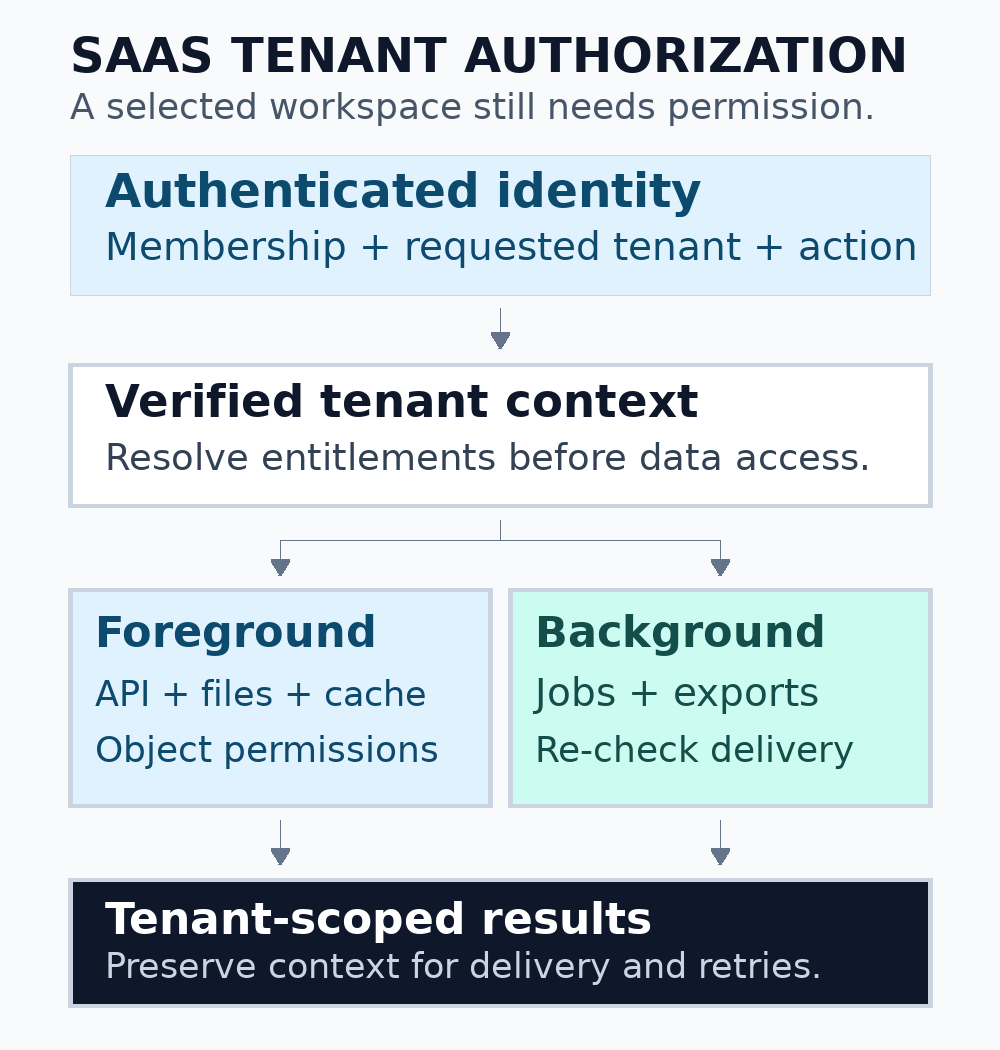
Figure 1. Treat tenant selection as a request that must be authorized, then carry the verified context through each execution path.
Check object access as well as tenant membership
Membership in the correct tenant may still be insufficient to read a particular record or perform a sensitive action. A billing administrator, a sales agent and an external collaborator can have different permissions inside the same organization. Review both the tenant boundary and the relationship between the caller, the object and the requested operation.
Do not treat a hard-to-guess identifier as authorization. OWASP’s API guidance describes object-level authorization failures involving sequential identifiers, UUIDs and other formats. A valid session and a valid object identifier do not establish access by themselves. Verify the action against the object in every applicable handler. See OWASP API1: Broken Object Level Authorization.
In code review, trace an operation from its entry point to the final data access and side effect. Check whether helper methods, bulk operations or alternative API versions bypass the normal authorization path. Include list endpoints and aggregate counts: an application can disclose sensitive relationships through search suggestions or totals even when individual detail pages are protected.
Use database controls with a verified role model
Database controls can provide another enforcement layer, but they need to be tested under the application’s actual connection roles. PostgreSQL row-level security can restrict applicable row access. When enabled without an applicable policy, it uses default-deny behavior. Table owners normally bypass row security, and superusers or roles with BYPASSRLS bypass it; ownership and role design therefore matter. Review the PostgreSQL row security documentation before designing policies.
Keep migration and administrative credentials separate from routine application access. Test policies using the role employed by the running service, not only a powerful development account. Examine how connection pooling resets any tenant-related session state. Test consecutive requests from different tenants on reused connections and confirm that failures do not leave the next request in a previous customer’s context.
Review relationships and uniqueness rules against the intended scope. A customer-defined code might need to be unique within a tenant rather than globally. A foreign key must not allow a record in one tenant to reference another tenant’s private object accidentally. The exact constraint design depends on the schema and database; document it alongside the application checks and migration tests.
Follow the boundary into caches, files and workers
Review cache keys and invalidation rules for tenant-dependent results. A record identifier alone may not identify the full authorization context. Include the dimensions that determine whether a cached response can be reused, and test permission changes as well as normal cache hits. Distinguish intentionally public shared data from tenant-specific or user-specific results.
For files, verify both storage placement and download authorization. Knowing an object path should not automatically grant access to private content. Review generated links, export destinations, attachment previews and lifecycle cleanup. Check whether a revoked user can still retrieve a previously generated link and define the expected behavior for the mechanism in use.
For background work, include tenant context and a stable job identifier in the task envelope. Validate the authority to enqueue the job, the worker’s permitted scope and the rules for delivering results. Review retries, cancellation and dead-letter processing. A successful foreground check is not enough if a maintenance worker later processes records without the same boundary.
OWASP’s multi-tenant guidance provides a broader checklist for tenant isolation across application components. Use it to challenge the inventory, then test the controls in the specific frameworks and services your platform uses. See the Multi-Tenant Application Security Cheat Sheet.
Build an authorized cross-tenant regression suite
Create synthetic tenants and users in an approved test environment. Define expected permissions before running the tests. Include an owner, a limited user, a revoked user and a controlled support role where those roles exist in the product. Use disposable records and exports so a failed test cannot expose or modify real customer information.
Test permitted actions as well as denied ones. A suite that rejects every request does not demonstrate a usable implementation. Exercise reads, updates, list endpoints, search, exports, file downloads and queued jobs. Confirm that the intended user receives the correct tenant’s result and that another tenant’s result is absent, including from metadata and aggregate counts.
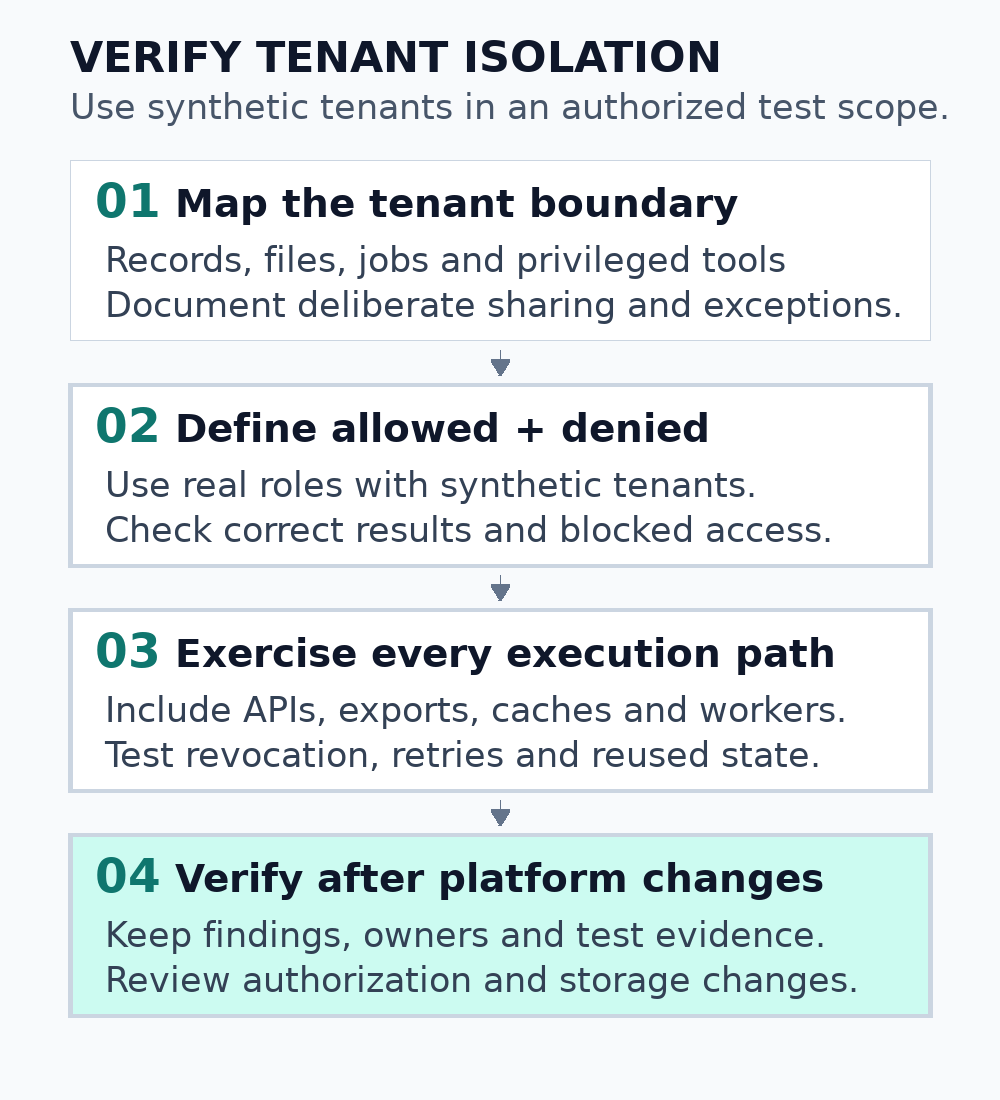
Figure 2. Re-run tenant-boundary checks after authorization, storage, caching and worker changes, using synthetic data and documented expectations.
Make support access and incident investigation reviewable
Define how support personnel obtain temporary access, which actions require additional approval and how access ends. Avoid a permanent, undocumented “all tenants” switch in routine tools. Record a meaningful actor and purpose when privileged operations are performed, and review whether an administrator can access the minimum information needed to resolve the issue.
Logs should help reconstruct tenant context without becoming another source of confidential data exposure. OWASP’s logging guidance discusses recording security-relevant events while excluding sensitive material such as credentials and access tokens. Review who can read logs, how tenant information is represented and how evidence is retained for investigation. See the OWASP Logging Cheat Sheet.
Finish the review with a boundary map, prioritized findings, responsible owners and regression evidence. State what was tested and what remains outside scope. Repeat the relevant checks after a new integration, permission model, storage pattern or support workflow is introduced. Treat isolation as an operational responsibility that continues after the first release.
Discuss a SaaS architecture or integration review
Informatix Systems can discuss the application, integration and security work needed for a defined SaaS project. A useful starting brief includes the tenant model, data stores, identity provider, integrations, recovery requirements and a description of the concern without customer data or credentials. Agree on deliverables and testing authorization before an assessment begins.
Explore custom software and integration services, or discuss your SaaS tenant-isolation requirements.